
How the parents of this "little sister" came to faith
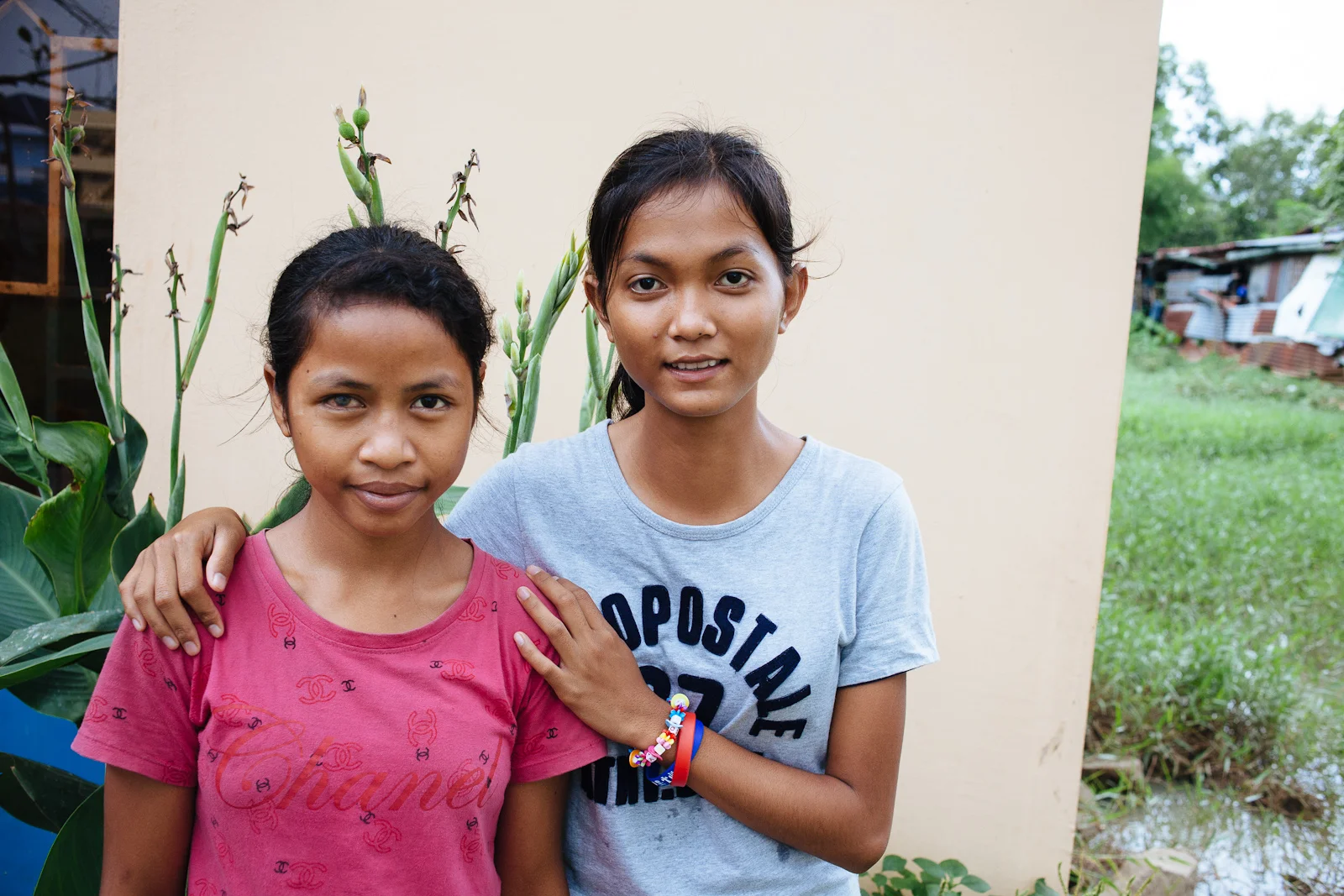
Saron says, "I saw her situation..."
“I saw her situation, and she was the same as me.”
Minea is thirteen years old. She has a gentle smile and doesn't shy away from my questions. Looking into her eyes, nothing appears to be seriously wrong with them. One eye is too red, that's all. Years ago her little sister was playing with a knife. She threw it, and Minea has only seen from her good eye since then.
Minea's family has often been a place of turmoil and violence. That's why it's so exciting that things are beginning to change...
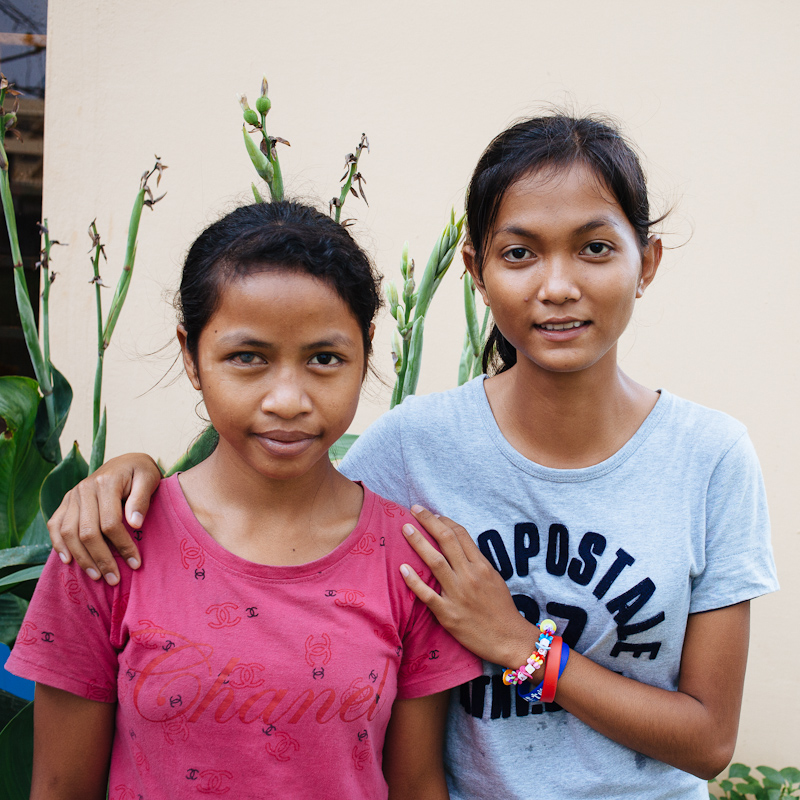
Saron is eighteen. She asked Minea to be her little sister just over a year ago. They were neighbors at the time, but then Minea's family moved to a new home thirty minutes outside the city. It's hard for Saron to go there, because she doesn't feel safe traveling that far alone, but she visits Minea as often as she can.
Usually they read the latest Alongsiders comic and talk about it. Minea says it helps her to learn more about Jesus, and she likes the practical lessons. She feels stronger now than she did a year ago and more aware of Jesus' love. In the future she hopes to work in a bank.
Saron says she chose Minea because, "I saw her situation, and she was the same as me."
It's a common thing for Alongsiders to say, and it's a powerful statement. Think about it. There are tens of thousands of vulnerable children in Cambodia, and each one is different. Every child has a unique story and individual challenges, and they live in thousands of local communities. How can we help them personally, wholistically and effectively?
That's a lot to hope for. There are some good organizations making a difference, but they can't work face-to-face with hundreds or thousands of children. But Alongsiders can, because Alongsiders live in the same local communities that the most vulnerable children call home - and most Alongsiders have faced similar challenges and vulnerabilities.
You may be asking, why did Saron identify with Minea?
Saron saw that Minea's parents were constantly fighting, hurling abuse at each other and also at Minea and her siblings. That's the same situation Saron grew up in, so she knew what Minea was enduring and wanted to walk through it with her.
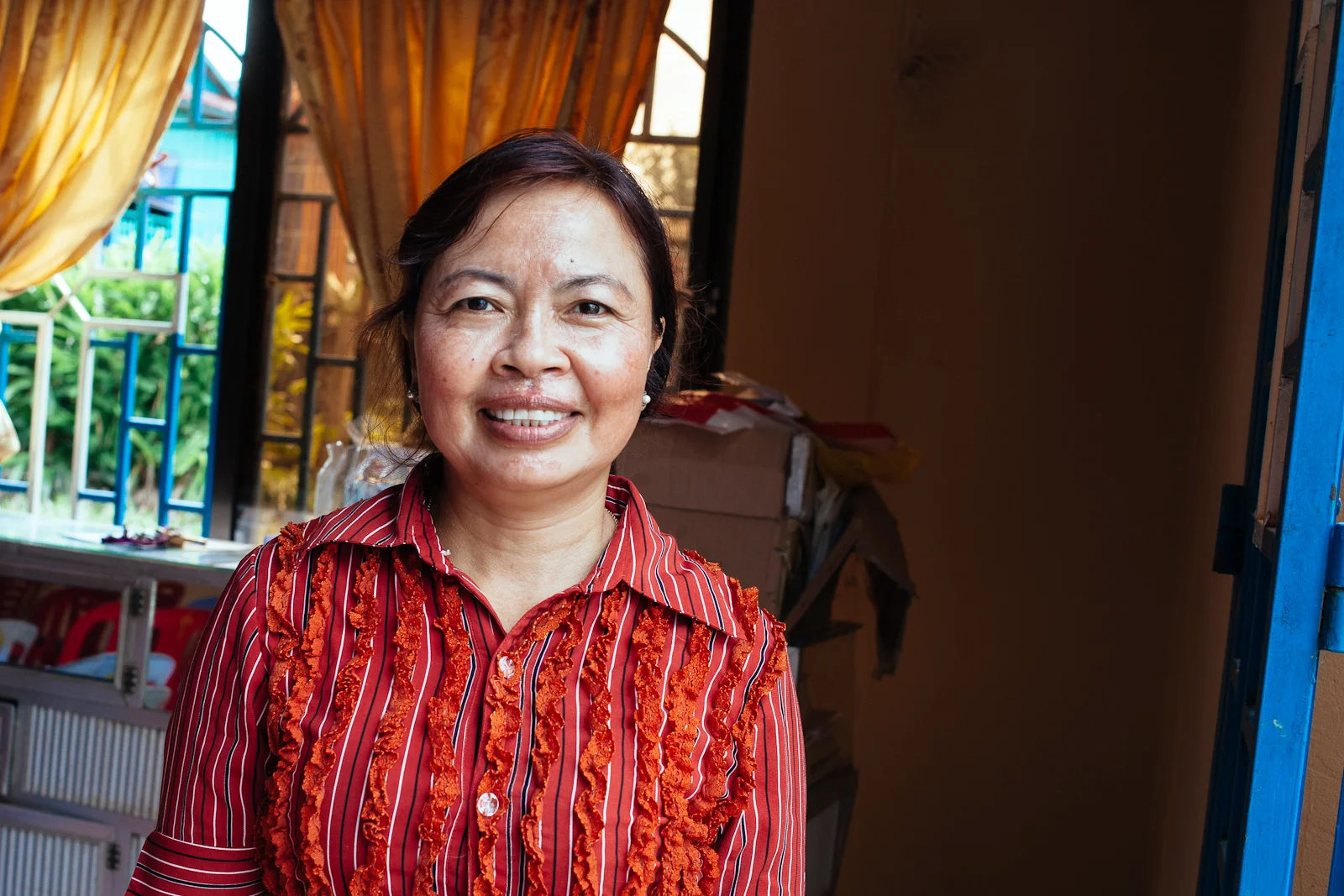
Saron's pastor is a gifted and compassionate leader
And here is the good news: Minea's parents have been changing. This year they came to faith in Jesus. In the past few months, they have been fighting less and less, and they treat Minea much better than before.
This isn't something Saron brought about alone. Members of the church had begun reaching out to Minea's parents before Saron ever became an Alongsider. In fact, Saron's pastor was the one who suggested that Saron consider asking Minea to be her little sister.For the past few months, Saron has been able to visit Minea by catching rides with her pastor - who has been going faithfully to visit the family.
Change and healing come through relationships. When a church community - and a family and neighbors and an Alongsider - come together in love, the results can be transforming!
Of course, some situations resist change.
On the day I met Saron, she had received the results of her high school final examination earlier that morning. The high school exam is extremely important, and she had passed! It's a big deal, so I congratulated her, but she was sad. Her grade was low, and she was afraid to go home and face her parents. They haven't come to faith, and her home is still an angry and abusive environment.
Saron hopes her passing grade will be enough to qualify her for a government sponsored nurse training program that educates tens of thousands of young Cambodian women each year.
I'm sure she would welcome your prayers, and Minea as well.
Why work with local churches?
I went to a rural church to follow-up with a group of Alongsiders, and I asked them how they chose their little brothers and sisters from all the children in the community. One of the young women started to cry as she answered...
I went to a rural church to follow-up with a group of Alongsiders, and I asked them how they chose their little brothers and sisters out of all the children in the community. One of the young women started to cry as she answered, and she said:
“I saw that one of the families in our community was suffering. The mother died, and the father went to Thailand to work and save money. Now the grandmother is raising all six children. I really wanted to help them, but I didn’t know what to do. After I heard about Alongsiders, I went and talked to the grandmother. I told her that I wanted to choose one of the girls to be my little sister, and she immediately said, ‘Yes!’”
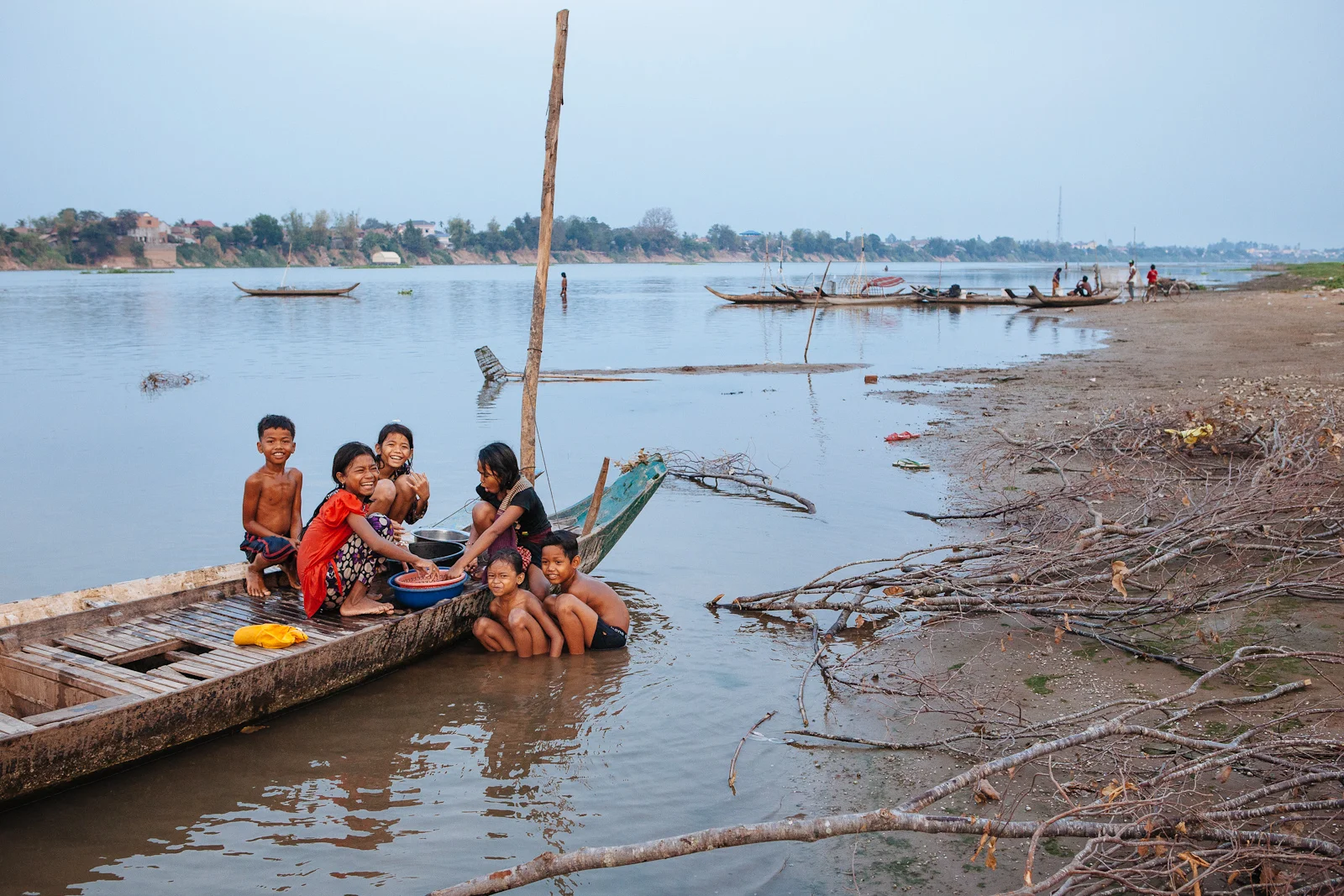
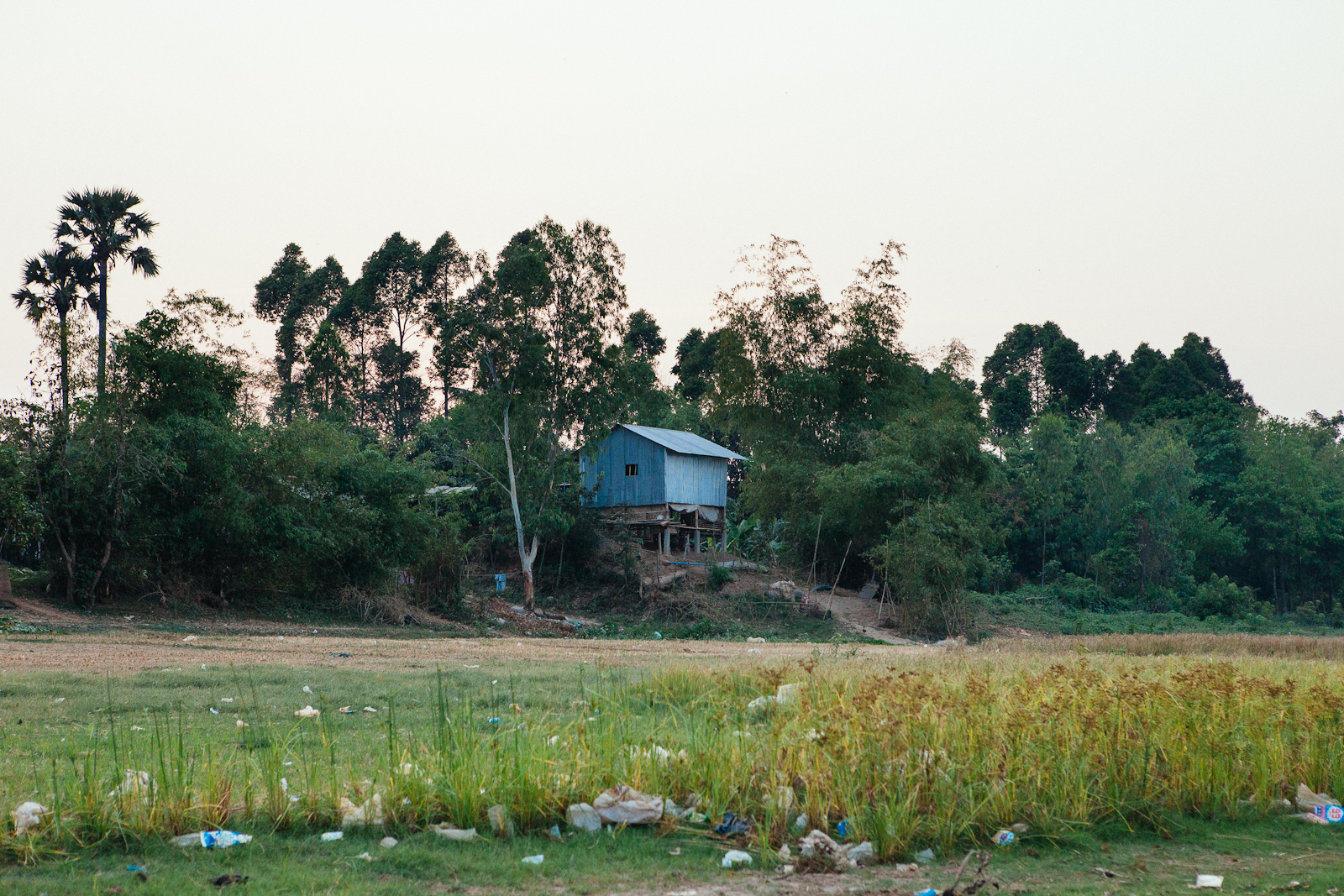
Community children in a riverside village play and do chores at dusk.
Phearom relates this story. He's one of the national coordinators for Alongsiders Cambodia, and he's constantly networking with pastors and visiting churches to invite the youth to join the movement.
His story is an illustration of why we work with local churches.
The young woman had a heart of compassion, and she was already connected in her own village and aware of people in need there. She was poised to act, but she was waiting for an opening.
There are others like her, and there are many, many remote villages in Cambodia. How can an organization based in the capital reach and mobilize them?
The answer that makes the most sense, especially for a Christian organization, is to work through local churches. Local churches are already in place in hundreds of remote villages, and their members already have relationships and local knowledge that organizations coming from outside dream of having. And the local churches come with leaders and structures included.
They are resources hidden in plain site, often overlooked because they are - like their communities - small and seemingly isolated.
Local churches aren't just gateways to villages, they provide critical backup for the Alongsiders. The little brothers and sisters don't just get the support and attention of one person, but they gain access to a community with varied gifts, wisdom, and resources.
When we work with a local church, the local church benefits.
Local churches are people, the Body of Christ with faces and names. Partnering with Alongsiders helps them practice evangelism in the truest sense: by embodying and proclaiming good news for people who are struggling and alone in their own communities.
Alongsiders is also discipleship in action, starting with the youth and young adults who participate (who are the majority in their churches). The young woman in the story above just needed encouragement to do something. As regular people like her take risks in faith and love, they will grow in Christ - and local churches will grow in healthy ways.
Finally, the communities benefit. Strengthening ties, building trust, and helping local people to face local problems together are all good development practices. Local churches can play a key role in serving their whole communities.
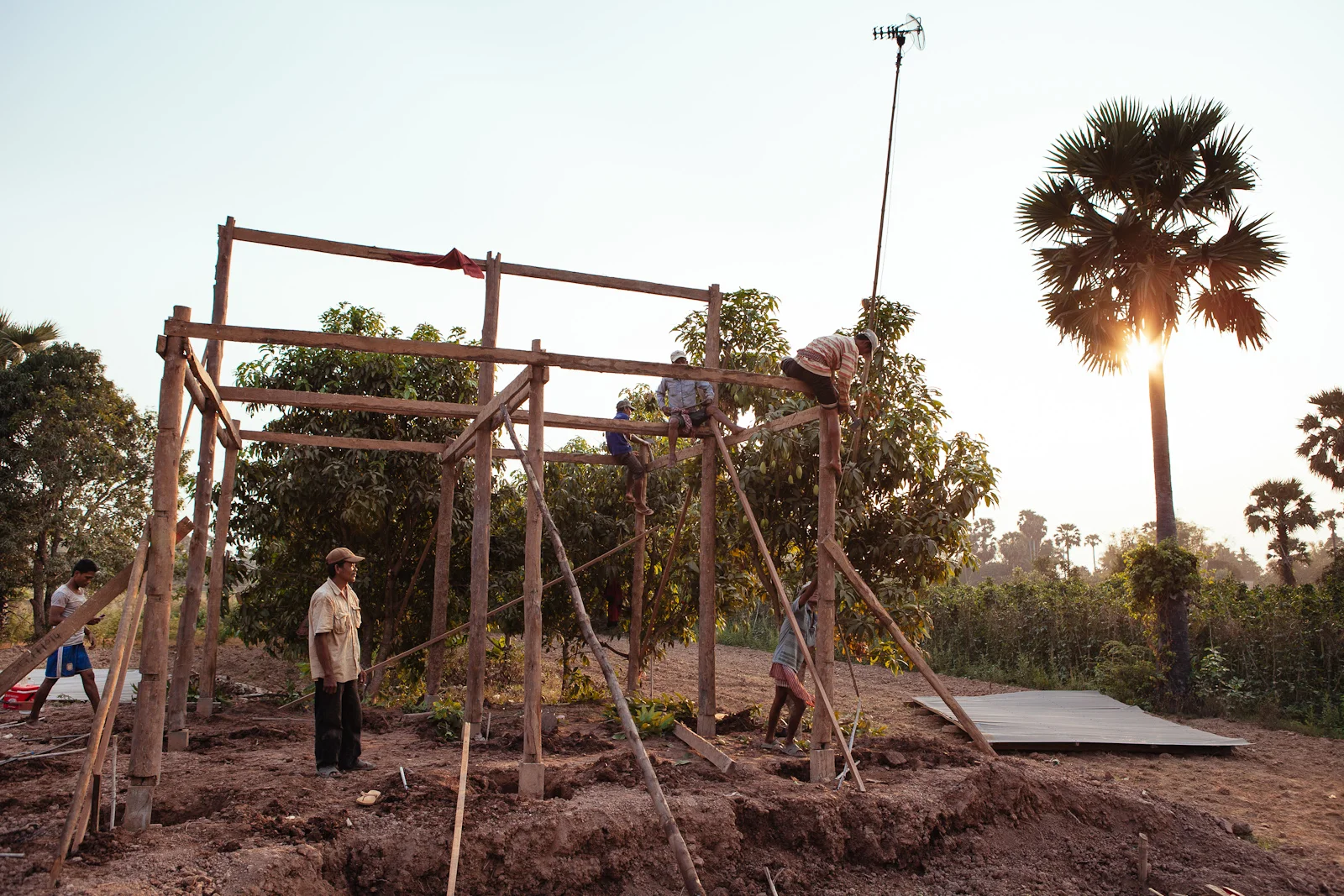
Local men in a remote village work together to build a simple house.
Despite all of the big words, what Alongsiders actually do for their little brothers and sisters is simple, and simply transforming.
And...you can do it, too.
Does your Christian community divide evangelism, discipleship, justice, and compassion into separate categories? Neglect one or more of them? Or put them off by calling them specialized roles?
Put them all together in love by coming alongside someone isolated and in need of a friend or mentor. You can be a light at the margins of your community, and no need to go alone. Invite others to join in!
There are also challenges in working with local churches. That sticky topic will be addressed in the next post!
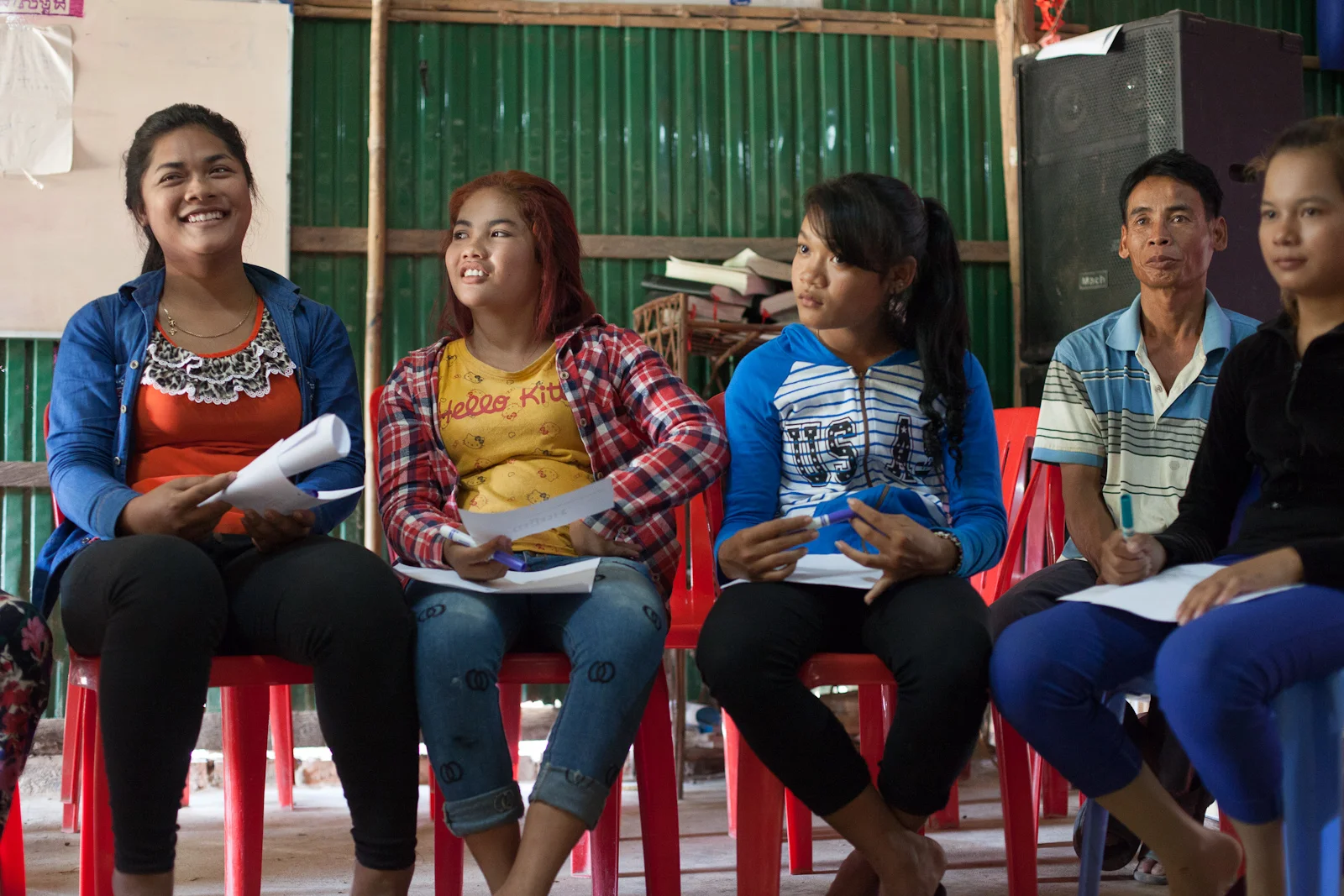
How to keep a movement going
Keeping a movement growing and thriving is not an easy task. But these two leaders have figured some things out...
Movements that change society emerge and grow in villages, neighborhoods, streets, and workplaces as regular people actively take their parts. Organizations may tend to centralize leadership and power, but movements must allow leadership and power to reside at the (human) edges.
Our goal at Alongsiders is to empower and release movements of young people who make long term commitments to walk alongside the most vulnerable children in their own communities. Such movements would transform individuals, churches, and society.
Big words. But these high hopes boil down to lots of young people in scattered communities at the margins of society and what they do with the vision entrusted to them.
Last week both Serey and Phearom, who direct and coordinate Alongsiders Cambodia, went to a village in Kandal Province to meet with a group of Alongsiders who joined about a year ago. The main purpose was follow-up, and also to orient some new Alongsiders.
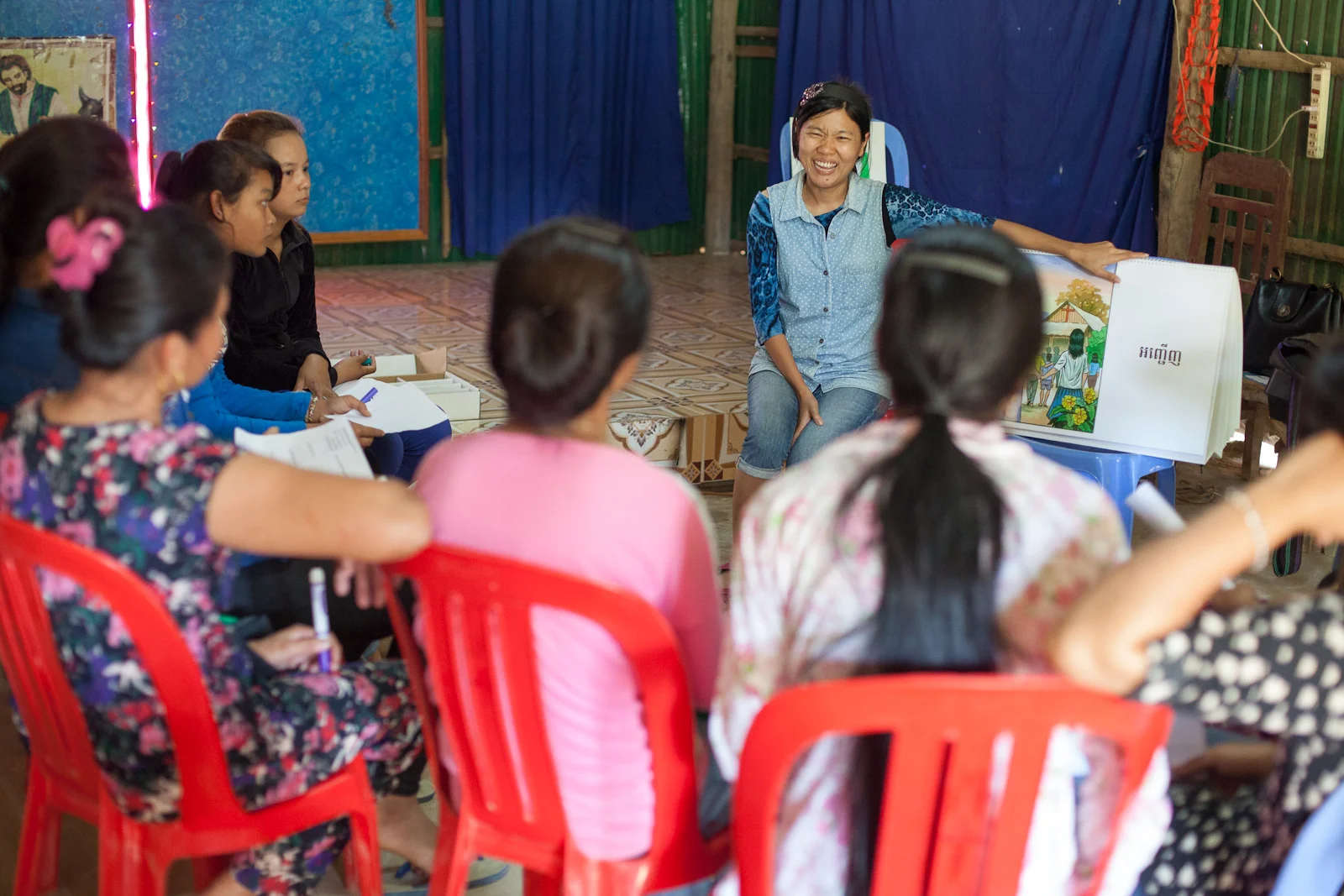
Serey teaches the 8 commitments of an Alongsider - using a flipchart
Becoming an Alongsider is a long-term commitment based on trust. Most of the time no one is looking over their shoulder to see if they spend time with their little brothers and sisters each week. They aren't paid or rewarded, except for an invitation to national camp each year. What they do flows out of motivation and character qualities like faithfulness, generosity, and a willingness to share as they learn and grow - all rooted in the love of Christ.
Yet most Alongsiders are young people whose character is still forming. It's a process of discipleship for them. They need words of encouragement and refreshment of the vision, plus examples to follow. That Sunday afternoon, Serey and Phearom took time to travel to the village and meet face-to-face. They carefully reviewed what Alongsiders is all about and talked honestly.
“When we meet with a group that has been going for six months or a year, we remind them of why they became Alongsiders and encourage them. They also hear what the others in their group are doing. That’s important, because they may not realize all that can be done. Many of them do better after we visit. Follow-up is really important, but it’s also a challenge as we grow.”
Serey was an Alongsider herself for years before she became the national coordinator. She epitomizes faithfulness in her leadership and in her ongoing relationship with her own little sister. She earnestly desires Alongsiders to be committed and faithful.
Phearom came to Alongsiders after serving in a national youth organization. He is passionate about education and mentoring. He hopes Alongsider mentors will be a potent force for education and change in Cambodian lives and society.
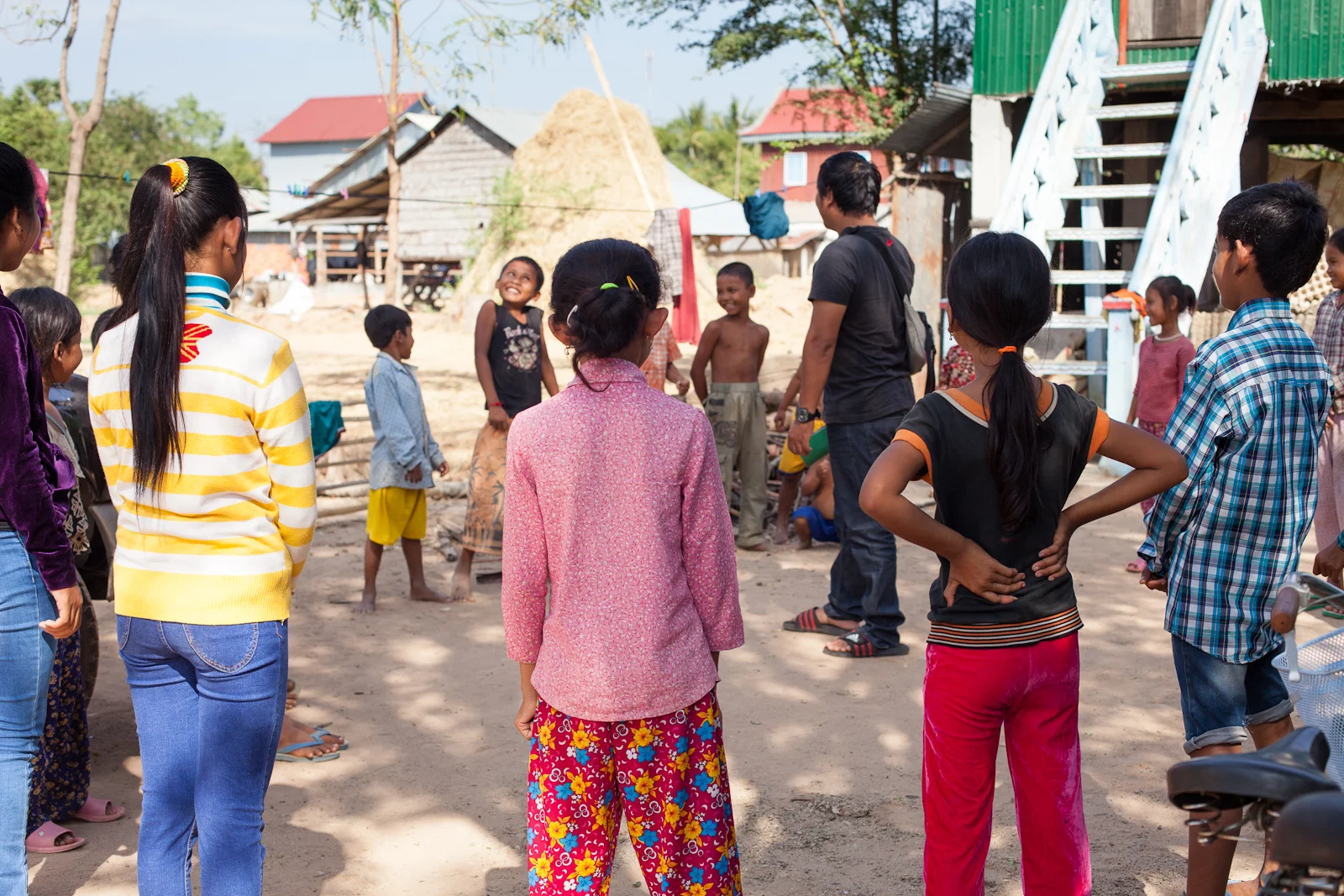
Phearom leads a group of little brothers/sisters in a warm up game
On this day, they trade off roles. Serey goes through the vision and expectations in all seriousness, while Phearom goes outside and organizes fun games for a group of little brothers and sisters and their friends. Later he comes inside and leads a discussion about child protection issues, and he encourages the Alongsiders in his own humorous way.
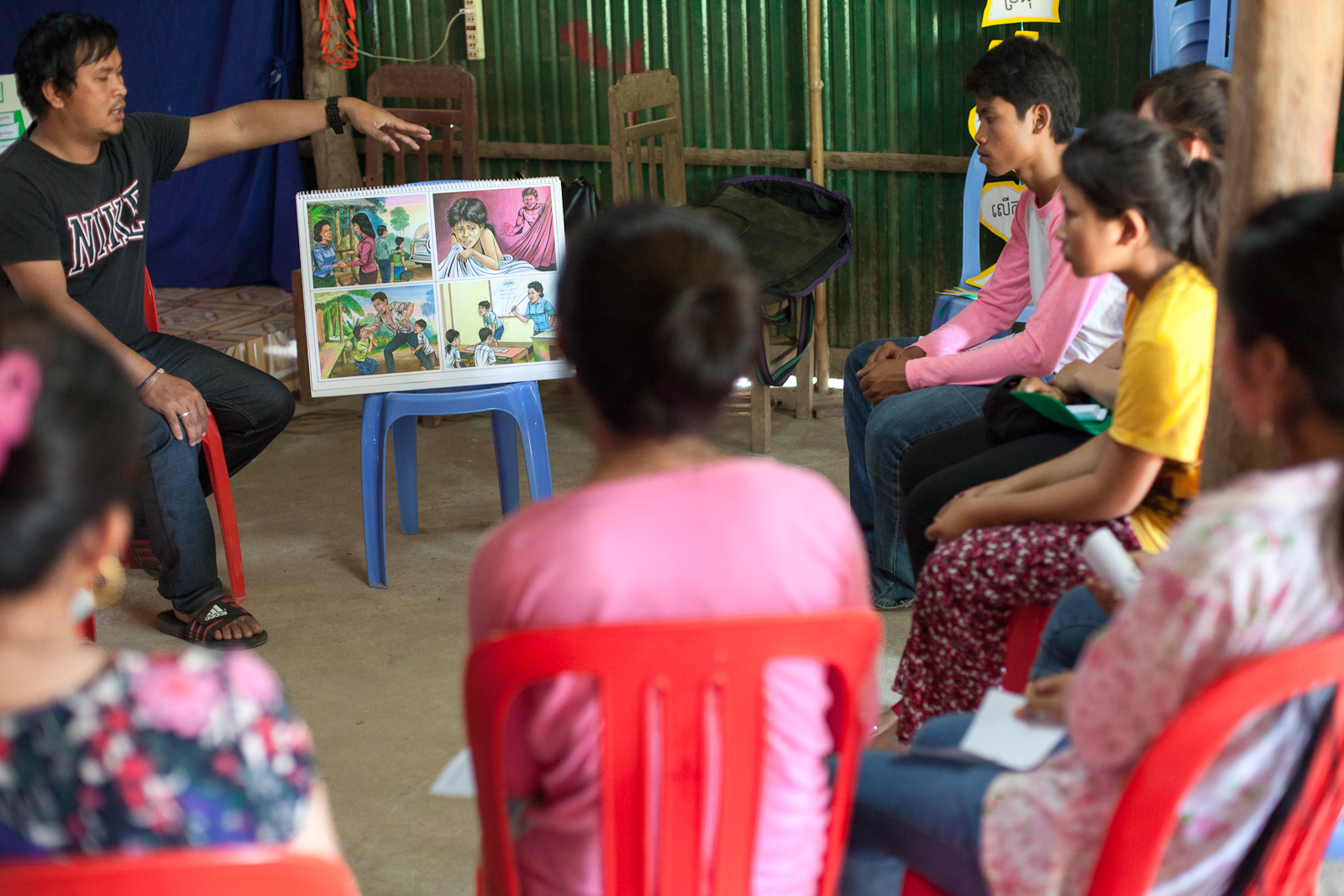
Phearom teaches on how to recognize trafficking or abuse... and how to respond.
The two compliment each other: Serey's stability and Phearom's zeal. They are both very earnest about Alongsiders. Afterwards they offer candid assessments: two or three in the group seem very dedicated, a couple are less sure. But it was a good meeting.
And then it's time to go and release the movement back into the hands of these young people. And trust God.
The Body of Christ is moving.
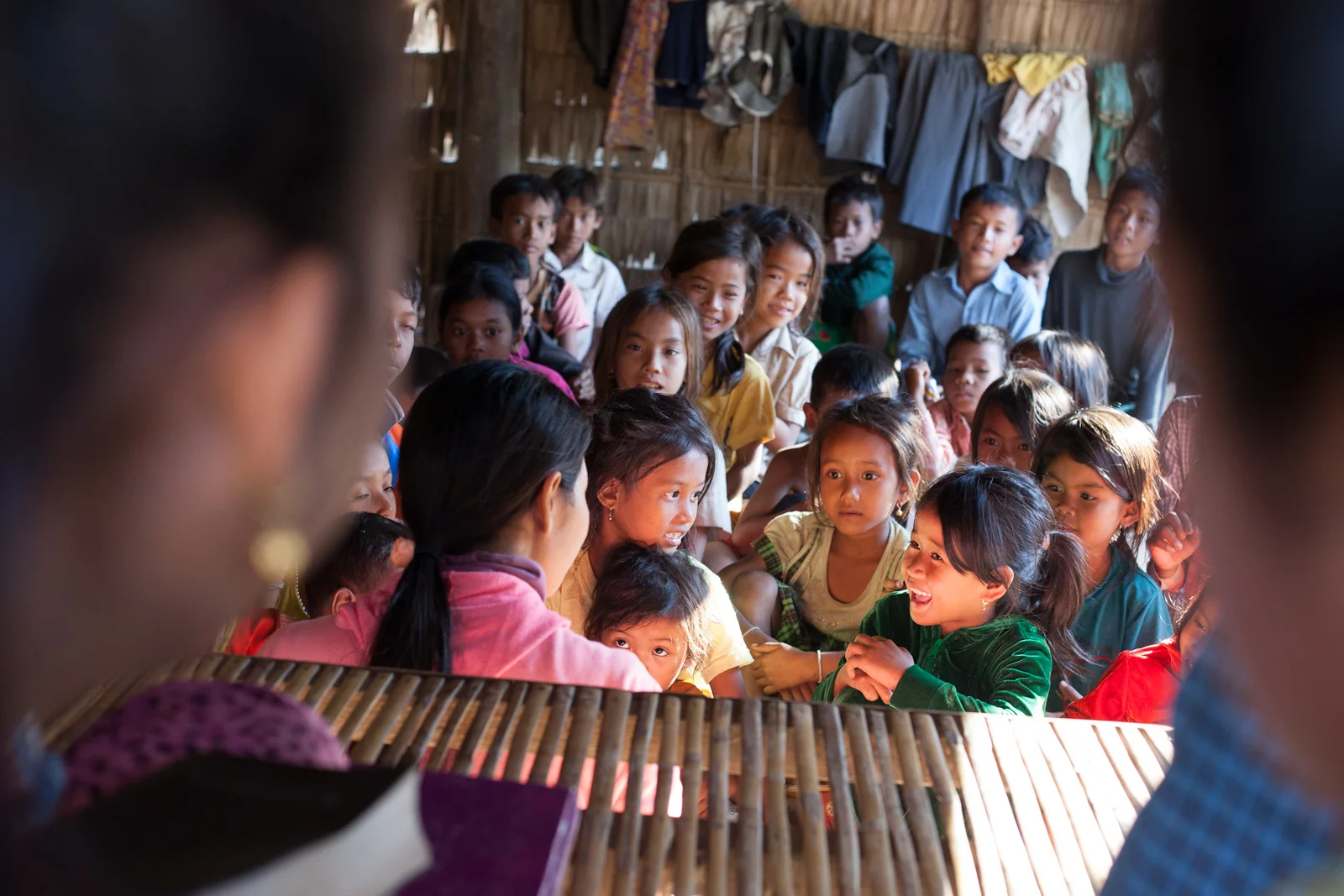
This young leader faces a big dilemma. Her story will inspire you.
There are extraordinary people hidden just out of sight at the margins of society.
“I am less interested in the weight and convolutions of Einstein’s brain than in the near certainty that people of equal talent have lived and died in cotton fields and sweatshops.”
Chanthy is not average. She's really quite amazing and unique. She's an example of why we want to empower and release Cambodians to lead, rather than relying on the tired model of foreigners controlling the wheel.
As Stephen Jay Gould attests in the quote to the right, there are extraordinary people hidden just out of sight at the margins of society.
Chanthy is a farmer's daughter with exceptional energy and capacity. Though few, perhaps, are quite like her, many capable yet unrecognized Cambodians are ready to love and lead in surprising ways.
Four months ago, Chanthy gathered a dozen or so youth from the rural church she pastors, and they all became Alongsider mentors together. She is the small group leader. On the day they officially signed up, she was charged with excitement as her new little sister stood beaming beside her.
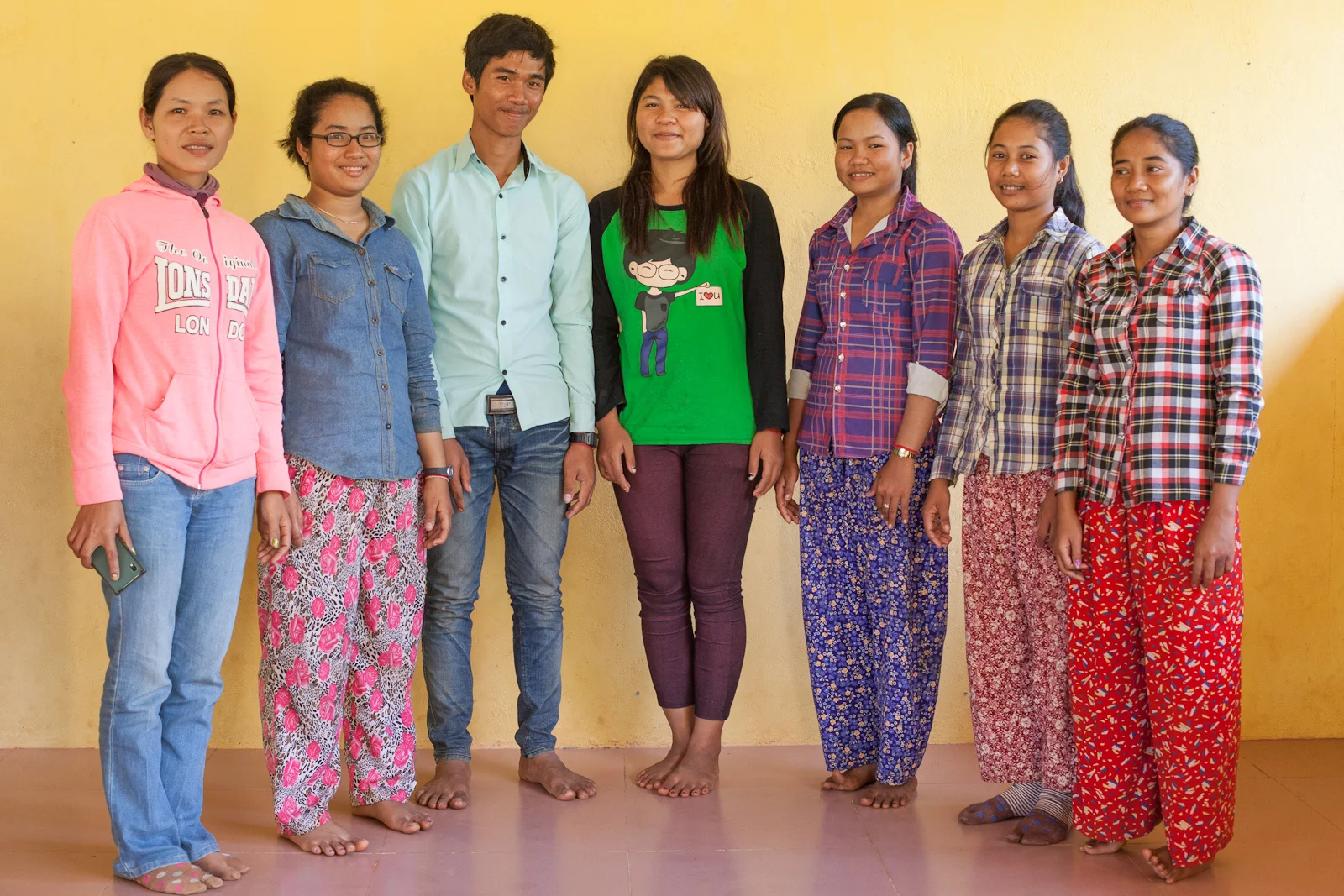
Chanthy, left, with six of the new Alongsiders from her community.
That evening she returned home after dark and helped her parents tend a tremendous pot of curry simmering over coals outside their house. It cooked all night, and the next morning they rose together before dawn to crack coconuts and squeeze the pulp, shell garlic, and add the final spices. About 6:30 a.m. people began arriving and leaving with enough delicious food to feed their families. They fed more than 200 people that day.
Chanthy's family isn't rich. They saved for months for that day. It was during the week of P'chum Ben, one of the most important Buddhist festivals in the country. As devout Buddhists, Chanthy's family had brought food to the local temple every year and given it to the monks. In theory, the food they gave was supposed to help feed the poor, but that didn't always happen. After coming to faith in Jesus, the family decided to continue to tradition, but they elected to give food directly to the poorest families in their community.
This year was the first time they tried it.
Chanthy had come to faith first. She walked over to the Christian church to learn what Jesus was about, and she never turned back. That was just over a year ago, and it didn't go over well. "My parents scolded me," she says. It must have been a serious scolding, because she moved out of her home and slept at the church for three months. But it was her parents who relented, and soon after her whole family put their trust in Jesus as well.
Chanthy is a force that's hard to resist. At some point in her life she developed a very strong character.
She was born in a refugee camp in Thailand. Her parents had fled there when Vietnam invaded Cambodia in 1979, and they stayed for the next twelve years.
When the family returned to Cambodia they erected a shelter on a piece of land in an isolated village north of Phnom Penh, and they began the nearly impossible task of starting from nothing as rice farmers. After some years of hard-scrabble existence, the family desperately needed a break, and Chanthy provided it. She went to Malaysia, where she took a risk, employing herself as a nanny for a rich family. Many Cambodian nannies have endured tragic abuses, but fortunately Chanthy was hired by a good family. They paid fairly, and she even got to travel to Japan and Korea with her employer on business trips. When she returned home, she gave all the money she had saved to her parents, and they used it to build their house.
Now Chanthy is the assistant pastor at her church. The "real" pastor, she explains, lives in Phnom Penh and visits once a month.
She doesn't receive a salary. She rises at 3 a.m. daily to help fix food for the family. Then she goes to a nearby high school where she spends the morning selling snacks to the students. She makes about $1.25 each day.
On Sunday she drives a wide loop on her motorcycle and visits five "house churches." On the way, she buys a huge load of snack food using her earnings. At each stop, a crowd of children gather and listen to her share from the Bible. A few adults hover nearby, some listening and others idly chatting. When she finishes teaching, she distributes the snacks and moves on.
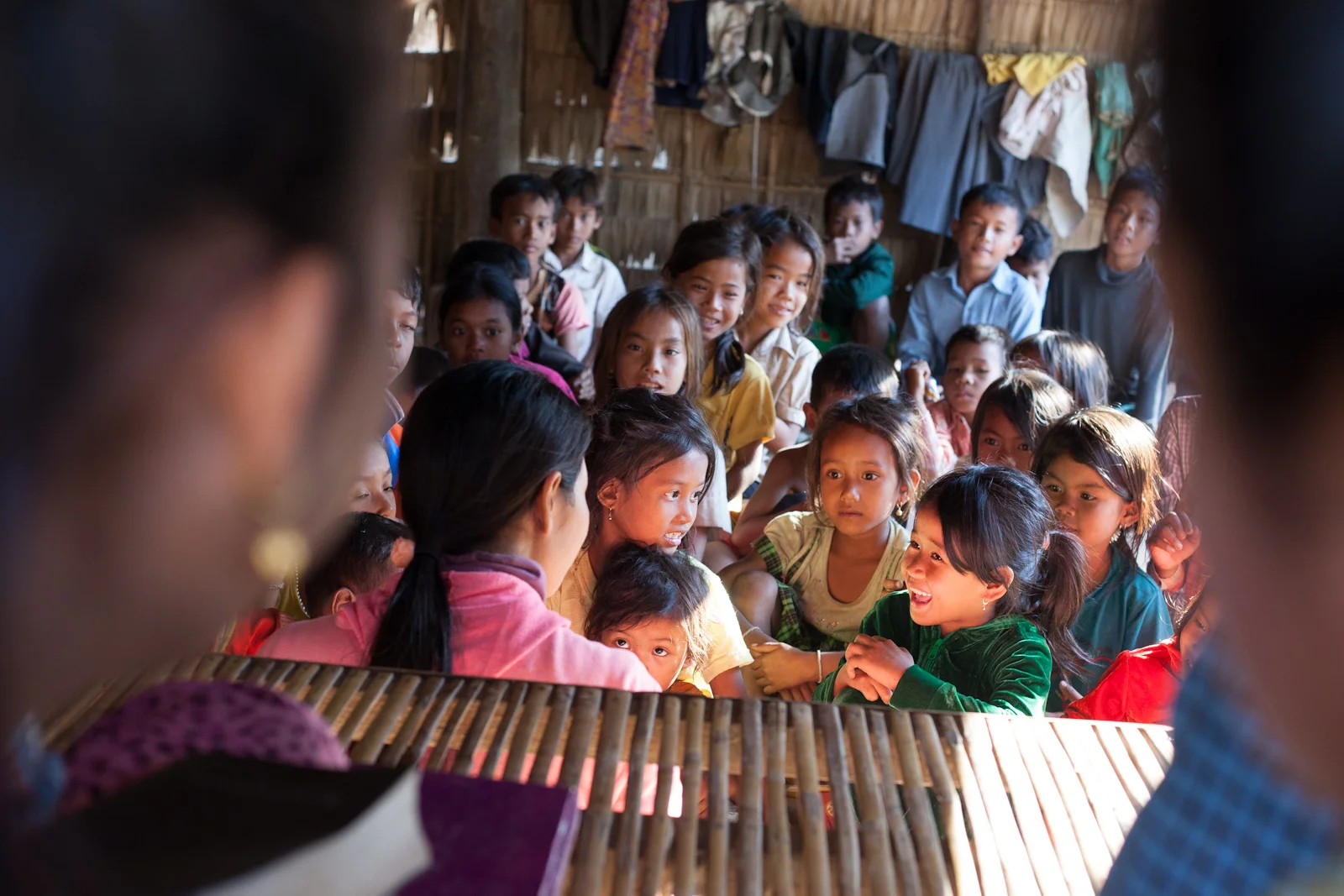
Chanthy teaches young children from the Bible. Afterward a group of older youth took their place and Chanthy led them through a more advanced version of the same teaching. Chanthy is learning how to teach the Bible at a Bible school in the nearby city, and each week she teaches what she recently learned there.
"I love children," she says, and she repeats herself until she is sure she has made herself clear. "I really love children. People ignore them and treat them badly, especially poor children, but I love them."
But later she admits she dreams of leaving the countryside, and she worries what will happen to the children without her. She points to the beauty all around and flatly states that she hates the crowded streets and noise of Phnom Penh. But she wants to learn more and expand her life. She feels, well, marginalized. "I'm not doing anything here, she says, oblivious to the incongruity in her words.
Herein lies the challenge. The big dilemma.
Alongsiders is working with young leaders at the grassroots. They are doing things and going places foreign workers and even Cambodians schooled in the cities could hardly emulate or follow.
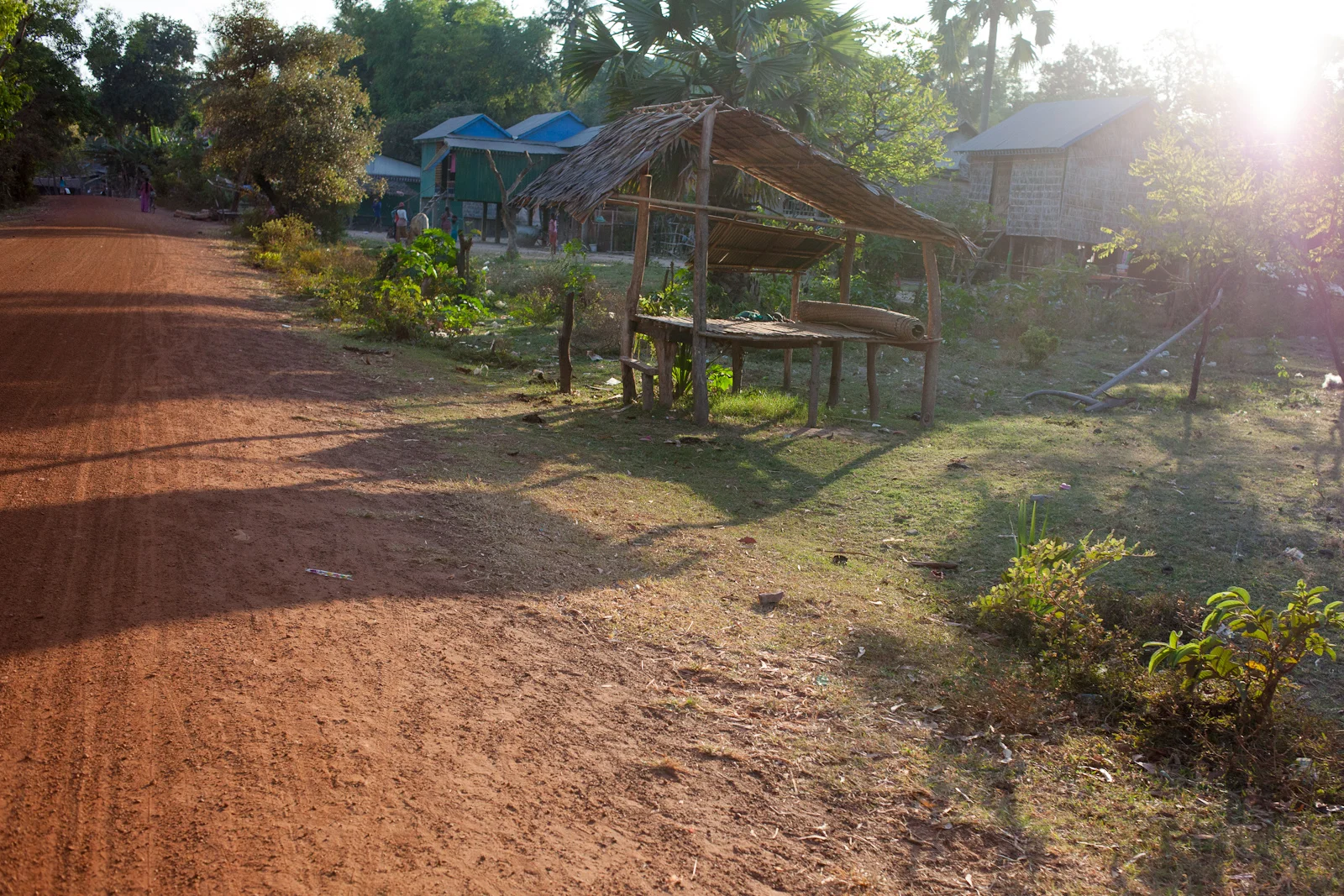
Yet they live in a world that tells them relentlessly, just as it tells us, that they are insignificant unless they land a particular kind of job or reach a certain status. If they shine as leaders, there are companies and big-budget organizations that will hire and take them away.
But we will not be discouraged. Right now the work of enduring beauty and significance in the Kingdom of God is being done by Chanthy and her fellow Alongsiders!
We often celebrate the children of Alongsiders - the little brothers and sisters - but today we're grateful for the Alongsider leaders and mentors, who are more often than not young men and women who have grown up at the margins themselves.
May we have eyes to see them, a vision that includes and expands with them, and a willingness to trust them with it. And let us learn to walk with them without using or corrupting them (and that, in itself, is a challenge worthy of writing about another day).
Thank God for them, and pray that the Lord of the Harvest - who must have an affinity with farmers judging by the way Jesus taught and talked about Him - will raise up more amazing and unique leaders to serve as Alongsiders.
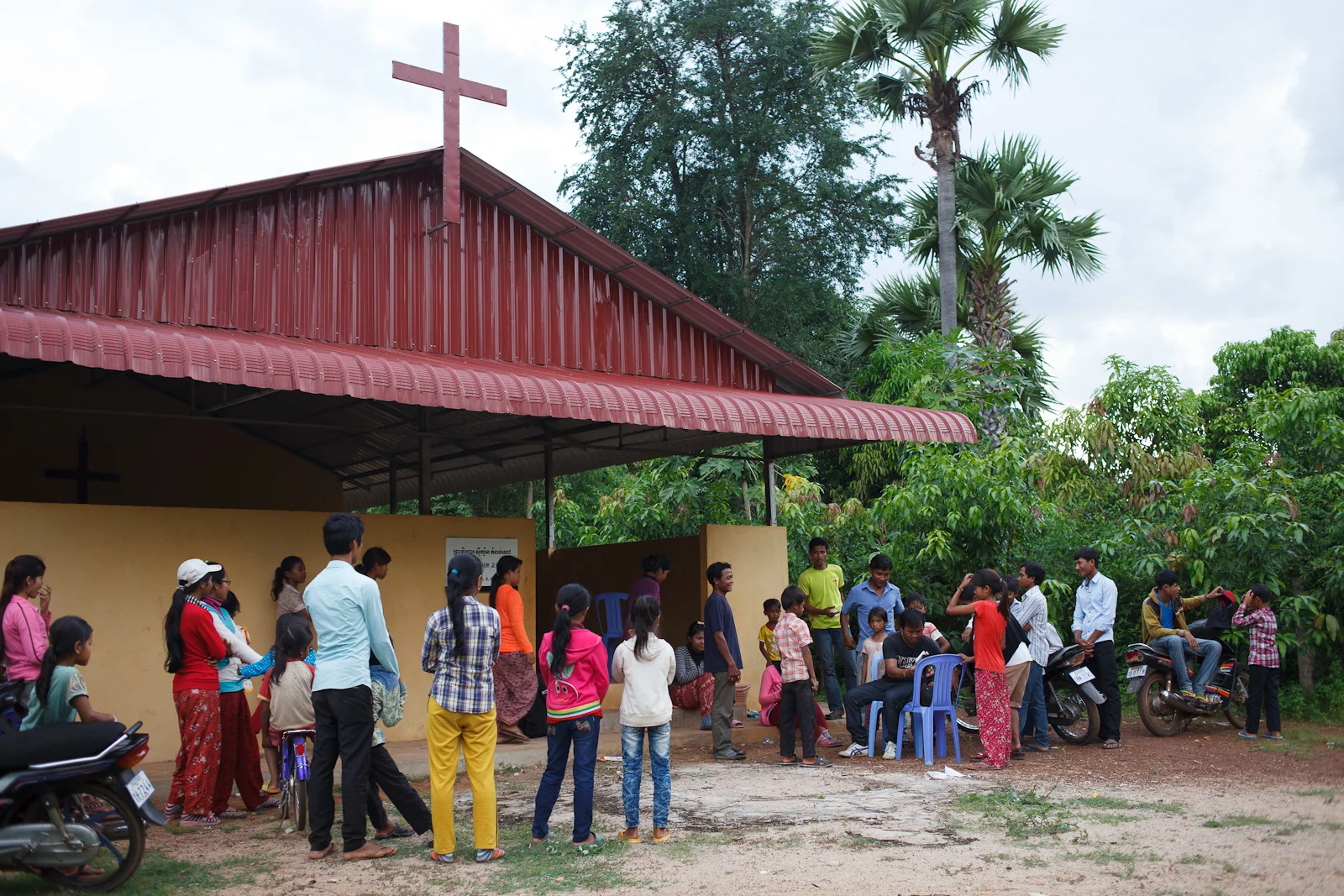
Why we work with churches, even when it gets uncomfortable
We work with local churches. If you’re nodding your head, or shaking it in concern, keep reading. Some of our reasons may surprise you.
We work with local churches.
If you’re nodding your head, or shaking it in concern, keep reading. Some of our reasons may surprise you.
Alongsiders doesn’t just work ON or FOR local churches; we work within them. We equip young church members, and they do the most important work of being Alongsiders. Most of that is done outside the view and control of our movement leaders who are in supporting roles.
Here are four reasons why we do it this way, starting with the easy ones.
1. Local churches are present in local communities almost everywhere.
Local churches are spread out all over the countries we work in. For example, in India we partner with a network of 3000 churches. What organization can claim to have offices and staff in so many places? Especially in places where the poorest of the poor really live? If there is such an organization, then it must spend a fortune on staff and overhead.
To reach thousands of vulnerable children we need a presence in thousands of local communities. Grassroots movements depend on grassroots structures and networks. Working with local churches means the structures we need are already in place where we need them.
2. Local church relationships are an important support network.
Most mentors are singles in their twenties. They may lack the wisdom and experience to respond to all the needs their little brothers and sisters may face. Family problems, abuse or entrenched poverty may require intervention by wise older adults. Mentors who are part of healthy local churches have a support network already in place to stand with them.
And that support network becomes a blessing and source of strength for the little brothers and sisters and their families too. Vulnerable children are often isolated and disconnected. By welcoming them into the local church, children gain an important support network which will be there to help them face the challenges of life.
In Alongsiders we often quote the Cambodian proverb: It takes a spider to repair its own web. In real life it often takes a community of spiders.
3. We believe in the gospel.
When Jesus started his ministry, he declared “good news (or the gospel) to the poor” and said:
(God) has sent me to proclaim freedom to the prisoners and recovery of sight to the blind, to set the oppressed free, to proclaim the year of the Lord’s favor.
We already speak a common language with the local churches. Or do we not?
Some Christians and churches have taken this gospel and spiritualized it as solely a message of salvation from sin. They interpret “poverty” and “blindness” and “captivity” entirely as metaphors for spiritual conditions.
Others believe Jesus addresses both spiritual and material poverty, disability, and oppression (and other dimensions besides), but they have struggled to communicate and live out a more complete (wholistic) gospel in their local churches.
As a result, many Christians concerned about the poor have supported Christian organizations which focus on compassion and social justice, while their local church attends to the "more spiritual" tasks.
But should a wholistic gospel be divided up this way?
If we believe Jesus announced such an all-encompassing gospel – that every relationship on earth and in heaven is being put right with forgiveness, healing, and justice – and if we believe Jesus is the Head of the Church, then can't we hope that the Spirit of Christ will guide us into the fullness of the gospel together?
So for the sake of the good news for the poor, Alongsiders as an organization is returning initiative and power to local churches through their members, entrusting them with a wholistic gospel message for the vulnerable, the disabled, and the captives among them, and empowering them to live it out.
4. We want to see local churches transformed.
Alongsiders works through local churches. And very often the mentors themselves, and even whole churches, are transformed along the way. This is not always a comfortable process for those in entrenched positions of leadership. The contribution of younger people is not always valued. But Jesus was a master at turning things upside-down and challenging the prevailing culture.
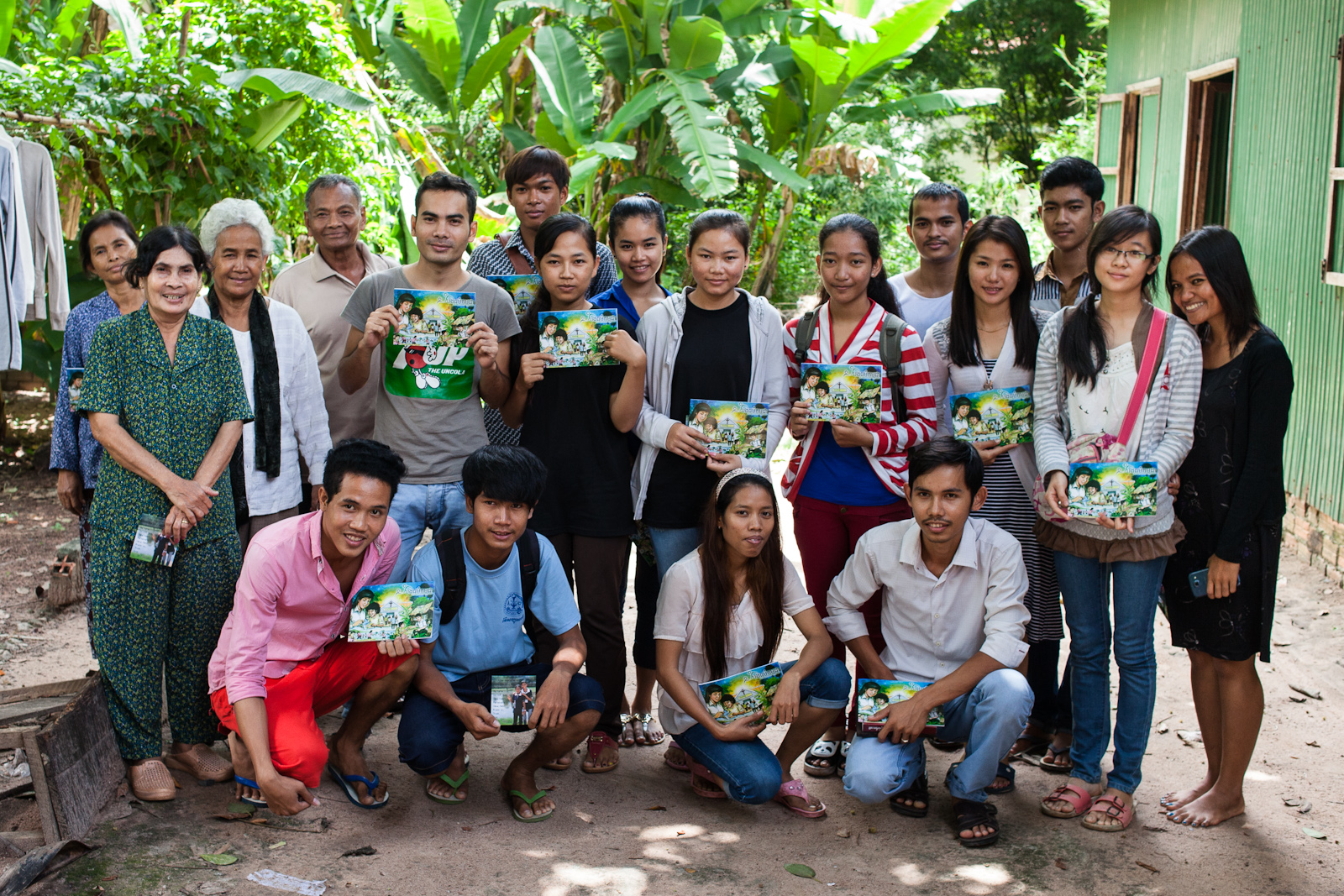
Church elders and leaders with a new batch of Alongsiders
The Alongsiders movement is not merely a movement to bring love and encouragement and discipleship to vulnerable children. It is also a movement of young people being transformed. We believe that in reaching out the poor, it is often WE who are most deeply impacted, OUR faith that is stretched, and OUR capacity for love that is enlarged. It is counter-intuitive, but central to the gospel, that when we lay down our lives for others we will actually find life ourselves. This is what we are seeing everyday in the lives of the Alongsider mentors. This is what is transforming the church.
Christ loved the church - to the point where He laid down his life for it (Eph 5:25). Despite all the problems and challenges of loving sinful human beings, we are called to do the same.
There are MANY more reasons we work through local churches, but most of all we long to see the Kingdom that Jesus announced being fulfilled...
On earth as it is in heaven.
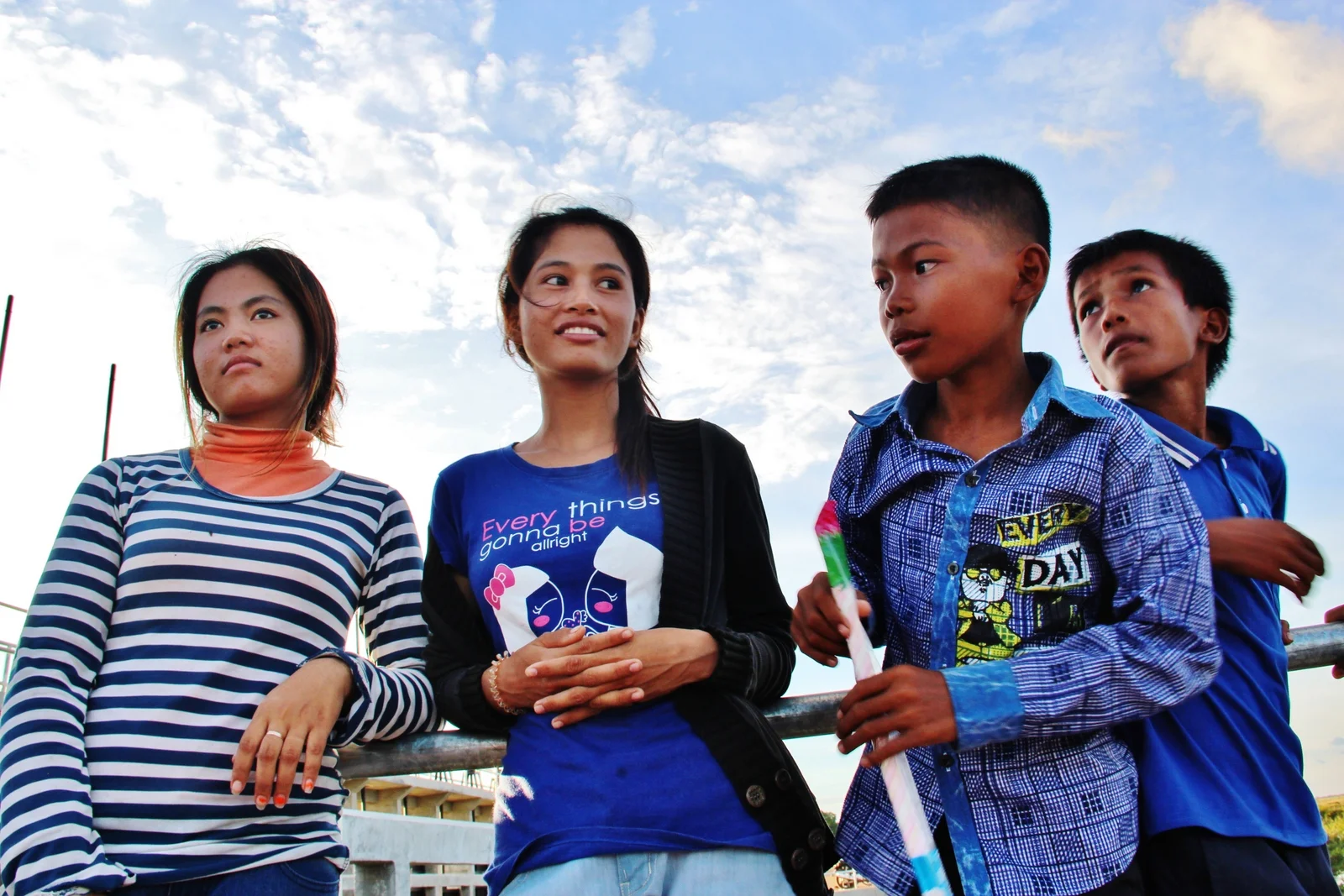
Why young people leave the church...it's not what you think.
Sure, young Americans are leaving the church, but young people in the developing world face very different pressures and challenges to their faith.
Statistics from North America suggest that large numbers of young people leave the church once they go to university. Some researchers estimate that between 61 and 88% of Christian youth in the United States leave the church in their early 20's.
(eg. "Barna study in 2006 -- "Most Twentysomethings Put Christianity on the Shelf...")
But young people in the developing world face very different pressures and challenges to their faith.
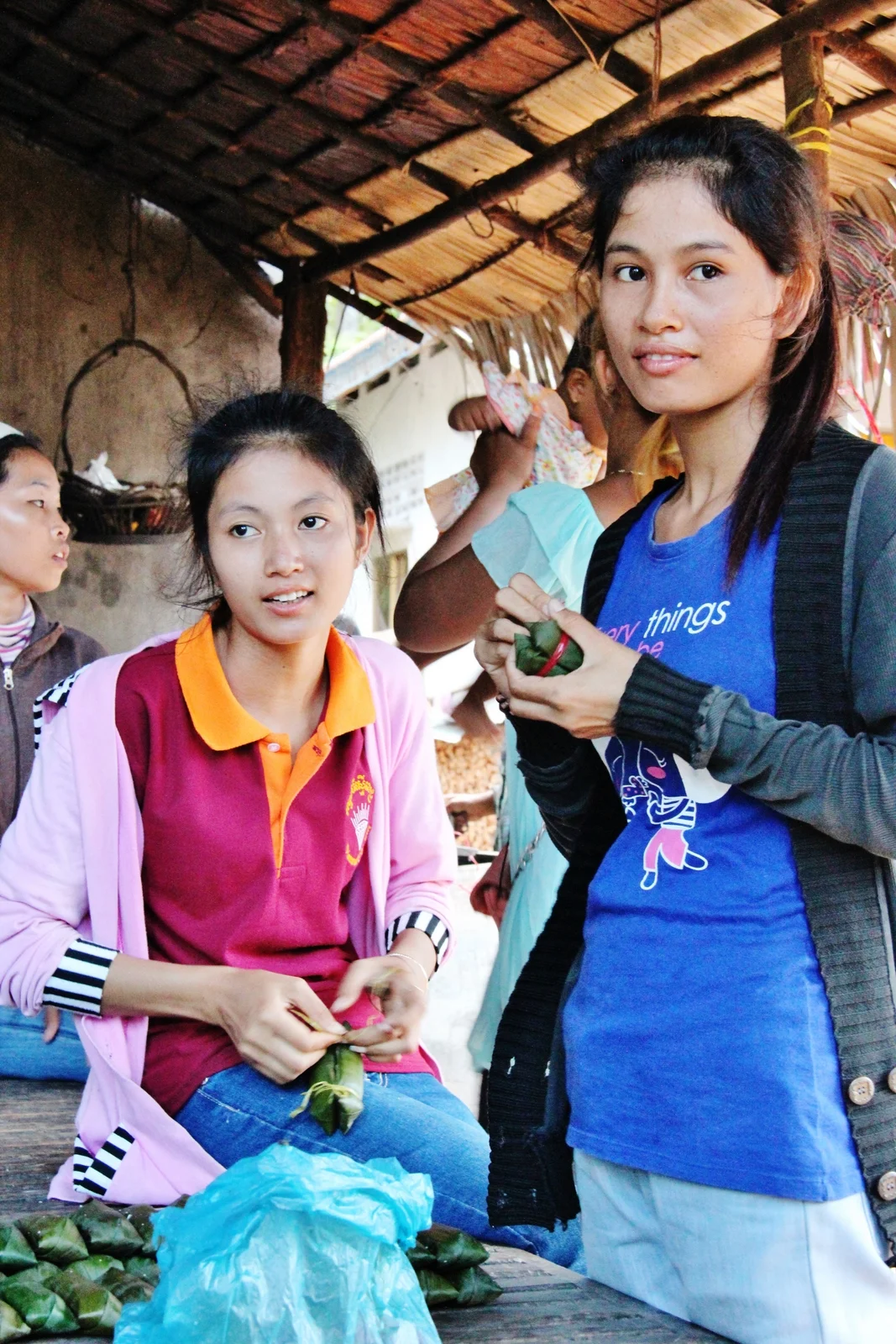
For many, those pressures are economic. They need to move far away from family and friends, and their church home, in order to seek work to support their impoverished families. Usually, that work will be low-paid with long hours - often 7 days a week - leaving no opportunity for fellowship with other believers.
One of our Cambodian Alongsiders, Bunhak, moved from his home town to Phnom Penh in search of work and study opportunities. Bunhak eventually found work at a fastfood restaurant. Long hours and a salary of around USD$80 a month, meant that Bunhak spent almost every waking hour either working or studying. There was little opportunity even to find local Christians in this big unfamiliar city, let alone join a church.
Urbanization is impacting developing nations all over the world, as young people - with fewer ties or responsibilities - move to the cities seeking economic opportunities. For many, this is a positive experience. But for others it can be disorienting, discouraging and even dangerous.
Alongsiders is seeking to learn more about their experiences and find ways to connect them into local churches on arrival in the city. With our wide network of partner churches - both rural and urban - we are uniquely placed to connect rural youth with local churches once they move to an urban center.
Key appointment in drive to do short term mission differently
Short term mission is broken. Its time for a change, and we know just the person to help.
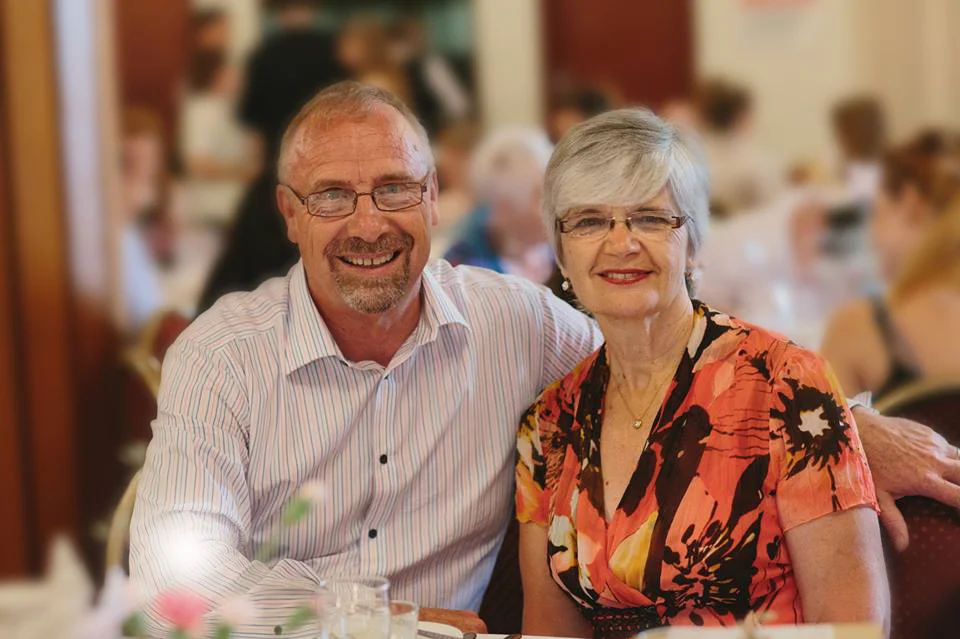
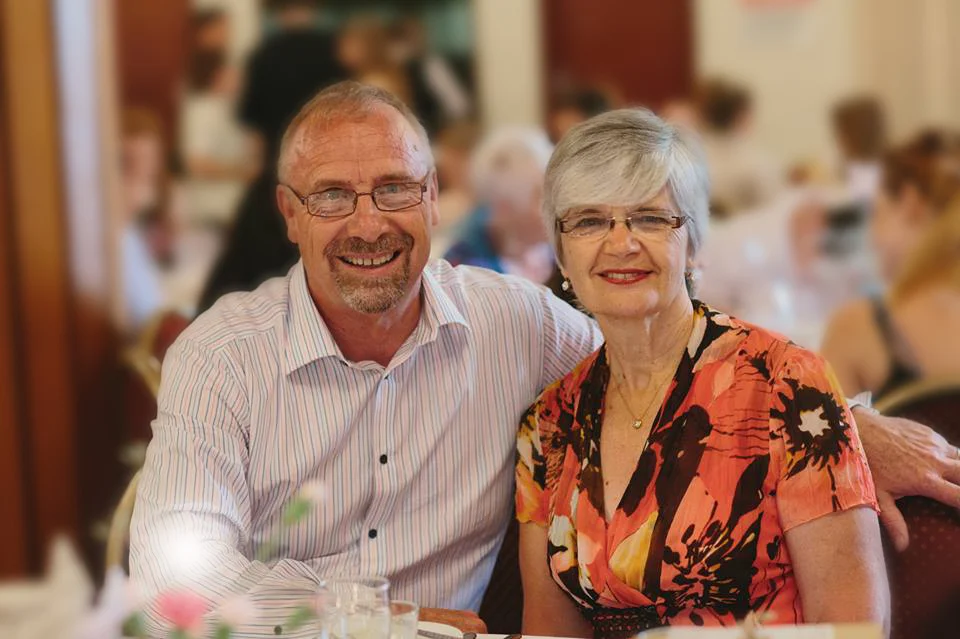
Andrew and Janice Collins
The Alongsiders International team is excited to welcome Andrew and Janice Collins, who will be relocating to Phnom Penh, Cambodia to work from our head office.
Andrew is a sought after trainer of short term mission groups - bringing insight and wisdom from his 17 years of service as the Australian Director of International Teams. He has consulted with churches all over Australia and beyond, helping Christians engage with the poor in more meaningful and sustainable ways.
Andrew will work closely with church partners and supporters from outside the developing world, to help them engage with the Alongsiders movement and journey deeper in their faith and engagement with poverty and justice issues.
An outdoorsman, he is a keen cyclist and walked 800km across Spain in 2008 on El Camino (a world famous pilgrimage). Andrew is also a fine cook, loves blue cheese, and is known for his delicious pancakes.
Janice Collins also brings a great deal of experience and giftedness to the team. A gifted administrator, Janice has served in government, seminary and more recently missions, leading International Teams in Australia after Andrew stepped down.
Janice is known for being efficient and focused, but beneath that is a heart of growing engagement with God's unceasing love. She is a wife, mother and grandmother of three (Harrison, Immanuel and Jemima). Janice enjoys walking, classical music - and a good cup of strong coffee.
We welcome Andrew and Janice to the team in August and look forward to their service to the wider movement.
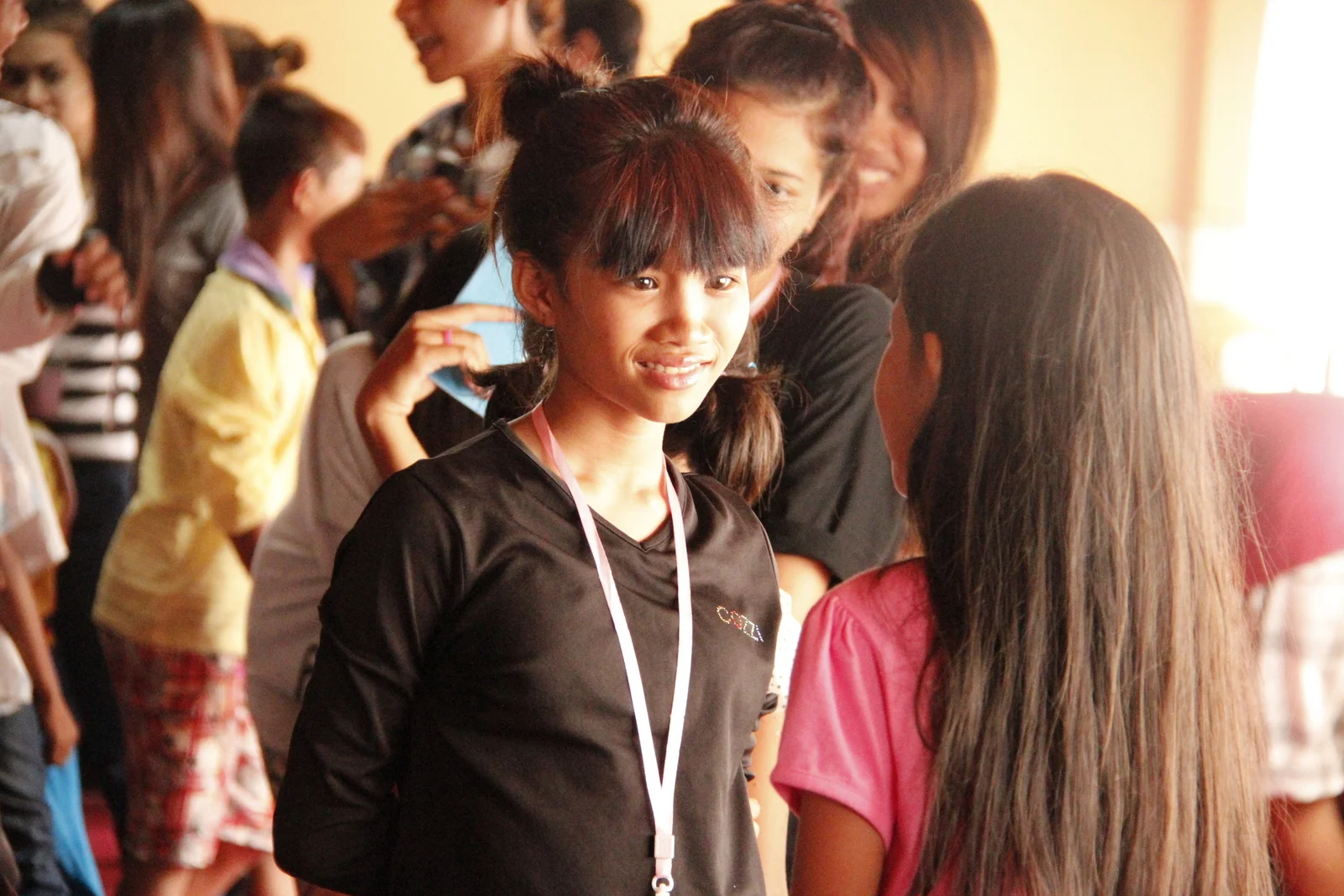
Spiritual transformation starts here
Bob Goff, author of Love Does, likes to say, "No one really gets discipled, they get loved; we learn what we see, not what we only hear about."
Bob Goff, author of Love Does, likes to say, "No one really gets discipled, they get loved; we learn what we see, not what we only hear about."
That's why we're reluctant to reduce the Alongsiders relationship to a study program or a curriculum. Truly it is love. And this love inevitably bears spiritual fruit. For if we experience another person loving us, then we are better able to understand that there is a God who loves us too.
‘My Alongsider showed me so much love when she comforted me when my parents were angry with me’. - Little Sister, Takeo Province
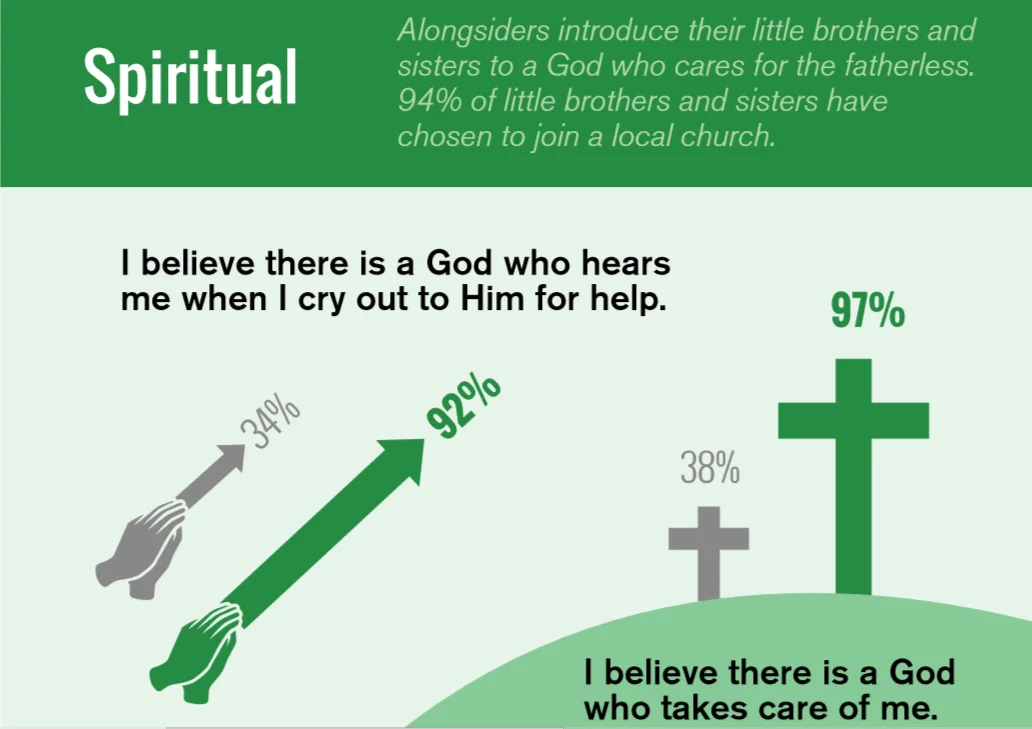
Recently, we asked our little brothers and sisters a few questions about their faith, and we asked questions of a control group as well. All up - we interviewed over 330 young people.
The study results show that something encouraging is stirring within the hearts of hundreds of little brothers and sisters across Cambodia. There is not only emotional, social and educational impact. There is spiritual growth too:

So how does it work? How does spiritual transformation begin?
Alongsider mentors are especially motivated to reach out to children who are neglected, orphaned and struggling. Such children typically experience feelings of hopelessness, abandonment and rejection.
As a relationship with their mentor develops, they are welcomed into the church family. In fact, 94% of our little brothers and sisters freely choose to become part of the local church. Through that loving community they gain a crucial support network and sense of belonging.
They learn that God loves them. And they begin to experience spiritual transformation.
Jesus taught us to welcome children into our midst. And he showed us the way to disciple and mentor others - by spending lots of time together, walking, talking and eating together. His methods of discipleship were not merely dry academic study. Instead, Jesus shared life with his disciples. They laughed, cried and ministered together.
Through the example of their Alongsider mentors, hundreds of children are experiencing that radical welcome and responding with joy. They understand that they are cared for and loved by God, both day-to-day and forever. They know that they are not alone. Because someone walks alongside them, Jesus-style.
[Research results mentioned above come from the Alongsiders Impact Assessment 2013. ]
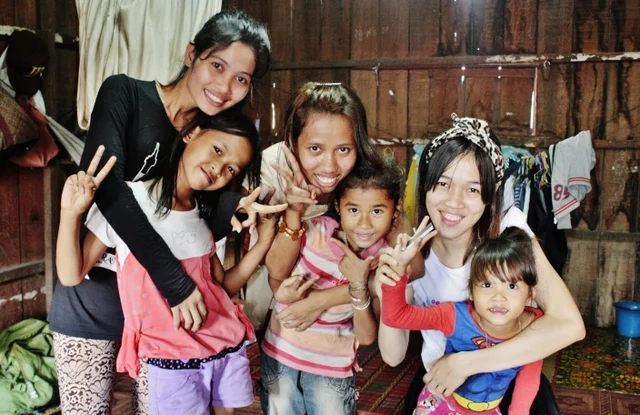
Six months in a slum – an intern’s perspective
In the days following her mother’s death, I remember longing to know how Dai, my 8 year old neighbor in this Phnom Penh slum, was doing.
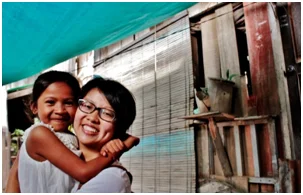
In the days following her mother’s death, I remember longing to know how Dai, my 8 year old neighbor in this Phnom Penh slum, was doing.
You can only imagine how I felt, when after the death, I heard a familiar voice cry my name, “Han-NA”!
Turning around quickly, I received the emphatic hug of a small friend, whose presence perhaps provided as much comfort to me as it might have provided to her.
When I think about Dai’s future, I cannot help but wish that someone would guide her in the coming years—someone who shares the language and background, someone committed to her in the difficult time ahead without a mother, someone who will point her to an ever-present hope in God.
Dai is one of a significant number of children, in my community alone, that could use such a person in their life... someone to walk alongside.
As children face the brunt of neglect and injustice in most of the world, the Church is called to respond. Perhaps then, rather than fighting the wrong battles, the Church can be the kind of people who live like Jesus, in coming alongside the forgotten— communicating to the world, thus, that the ones the world has rejected… are loved, valuable, and absolutely worthwhile.
I am still not quite sure how I got connected with Alongsiders exactly, but the connection was a God-send, undoubtedly. My deep-seated desire to see local churches actively engaging in the reconciliation and redemption of lives in their community, particularly through discipleship and education, is exactly what I found happening in Cambodia, through Alongsiders.
As a fourth year student at Wheaton College, Illinois, getting to be a part of what is happening in Cambodia through a six-month internship, is an absolute privilege. These crucial six months are an opportunity to glimpse of what God is doing in the world, in the heart of marginalized communities, and a time to experience the difficult tension between the “Developed” and “Developing” Worlds.
The experience provides a platform to
question, what it means to live, responsibly, as a Christian in a divided
world, and further, to think through principles that I will carry with me for the
rest of my life.
Every so often, one gets the opportunity to witness something in life that
makes the heart come alive, that is so obviously steeped in God’s presence that
it brings us to our knees, that is so extraordinary that it can only be the
Kingdom of God.
Within the last two months in Cambodia, I have experienced a few of these moments, in places, perhaps, least expected. Some of these have been with my Cambodian family in our urban slum—moments of deep grace when I had nothing to offer, but a throbbing head, a lingering fever, and a few Khmer words.
I have also had the privilege to bear witness to an extraordinary group of local young people committed to the life of one vulnerable child each, at the epicenter of the system’s injustices.
I have been able to see a Church alive and active, in the discipleship of their community’s at-risk children.
Quite frankly, the Life—in every sense of the word— that is being shared, is nothing short of remarkable.
It is that Life that I wish for my friend, Dai
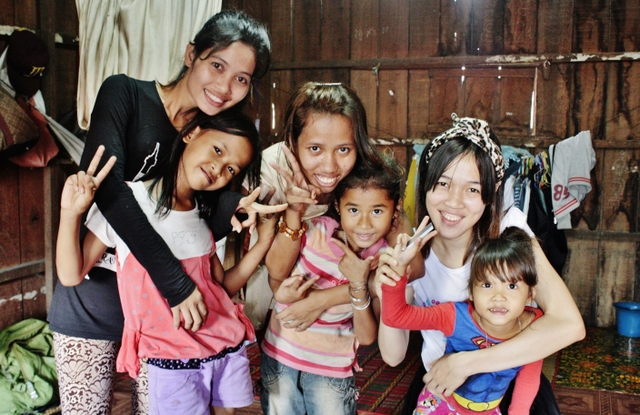
[Written by Hanna Tzou, currently interning with Alongsiders in Cambodia. Contact us for more information about internship opportunities in 2014.]
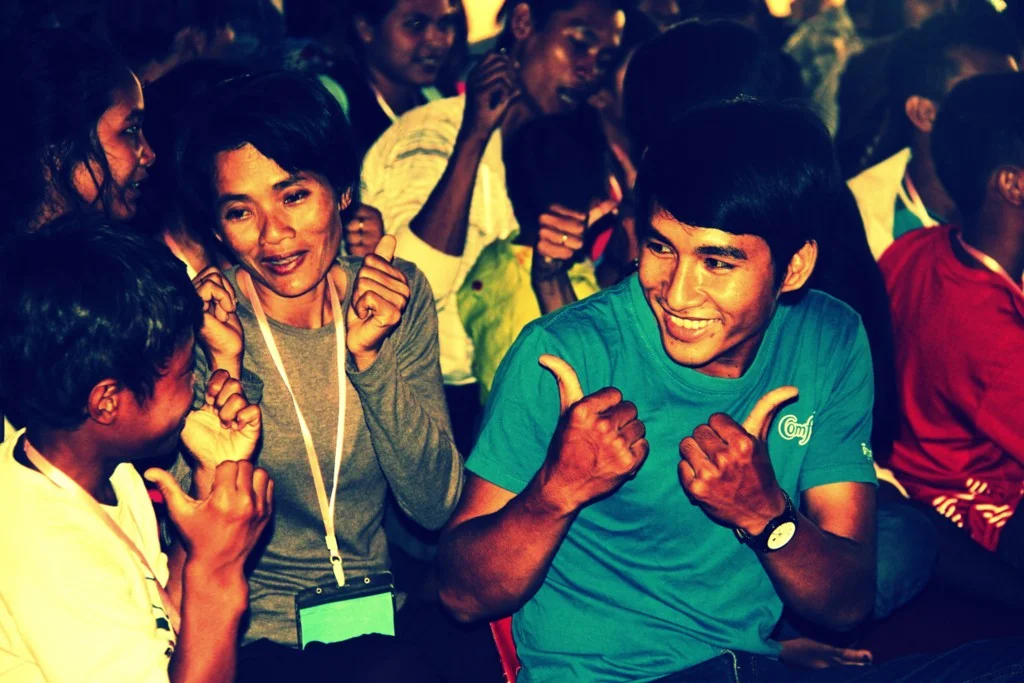
The power of groups
This unique model of working in groups distinguishes Alongsiders from other mentoring programs and reflects the deep commitment we have to building community - a central value for many people in developing world cultures.
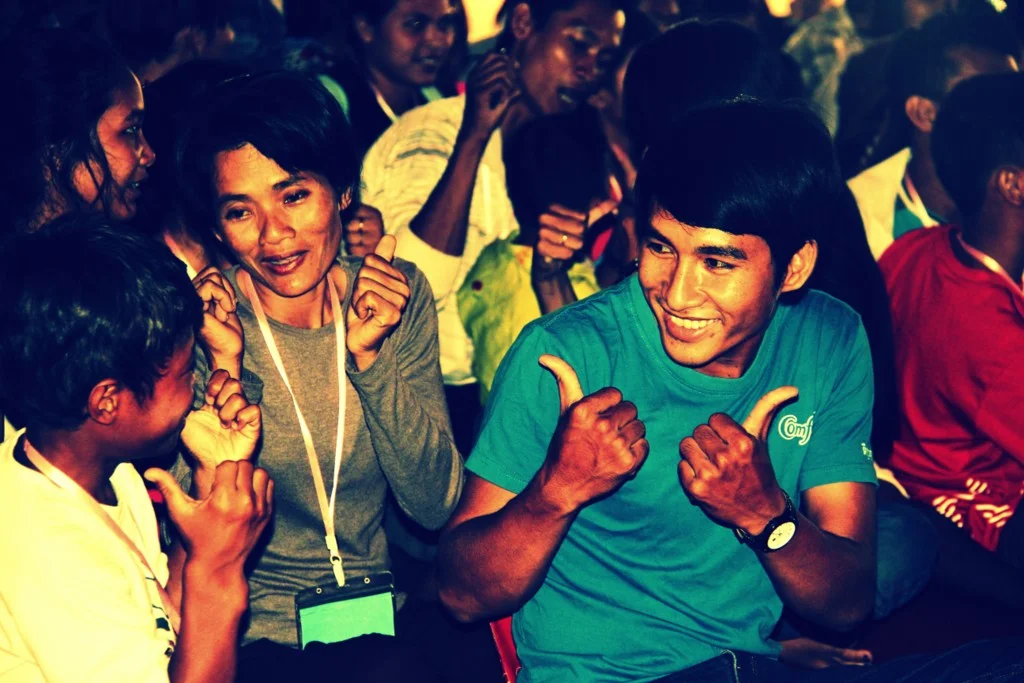
A few days ago we met with Alongsiders group leaders from across Cambodia.
It was an inspiring time of sharing what God is doing in each of their communities.
This unique model of working in groups distinguishes Alongsiders from other mentoring/discipleship programs and reflects the deep commitment we have to building community - a central value for many people in developing world cultures.
This is how it works....
Young Christians from a local church who want to become Alongsiders form themselves into groups of 5-10 people (though some groups are larger).
Each group receives training and orientation from leaders in the wider Alongsiders movement. (Each individual Alongsider is matched with one marginalized child in their own community for a long term transformational relationship.)
As shown in the micro-credit field, working together in solidarity groups provides an ongoing level of peer encouragement and sustainability that brings benefits to everyone involved.
Think of it as positive peer pressure!
But building community goes way beyond just working in groups.
When a marginalized child is matched with an Alongsider, they gain not just a relationship with a loving big brother or sister - but a relationship with the whole local church support network.
That's why we work through churches. Because they are able to offer spiritual, social and emotional support far beyond what any one individual could offer.
Alongsiders is building community, and opening a space for the most marginalized children to participate in that community.
Isn't that what Jesus meant when he said, "Whenever you welcome a little child in my name, you welcome me." (Matthew 18:5).
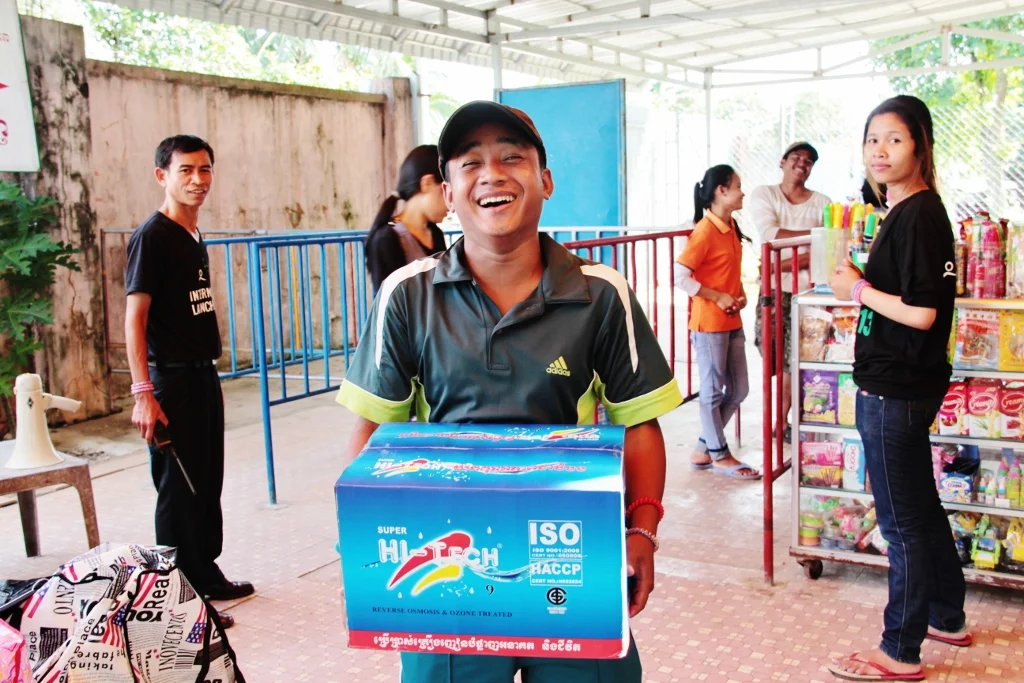
Now a youth leader - Theara's Story
We first met Teara and his siblings when their mother was dying. The last few months of her life were hard and they struggled to survive in a tiny shack that had a broken roof and walls.
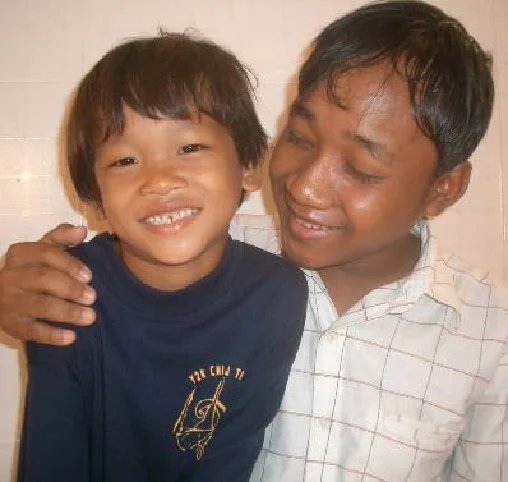
Teara and his "little brother"
We first met Teara and his siblings when their mother was dying. The last few months of her life were hard and they struggled to survive in a tiny shack that had a broken roof and walls.
Together with neighbors their home was rebuilt. Teara was so proud of the simple structure. Finally they had a home they could call their own.
But tragedy struck the first night they slept in their new home. A huge fire swept through the slum and they lost everything, including the only photos of their mother who had died a month before.
Eventually, Teara
and his siblings moved in with a Christian lady who opened her home to them and provided
guidance and love. They were matched up with mentors from Alongsiders Cambodia. Things finally were beginning to look up.
Over the years Teara became a keen member of the local church, eventually being entrusted with leadership amongst the youth.
Now, at 21 years old, Teara has officially become an mentor himself to an orphaned boy in the community, through the Alongsiders movement. He shared with us how he spent three months praying that God would show him which boy to choose out of his village.
When I visited Teara recently, I sat on the floor of his tiny home, eating rice and fish with Teara and his "little brother". They talked and laughed and I could see how much joy Teara's mentoring brought to this little boy.
Teara spoke of how he understood the challenges of beig orphaned, and how it was time to pass on some of the love he has received by being welcomed into the church family.
The second generation - Sros' Story
“I grew up without a father and we were very poor and it was difficult to get by. One day, a young man, Lee, who was older than me, asked me if I wanted to become his little brother…
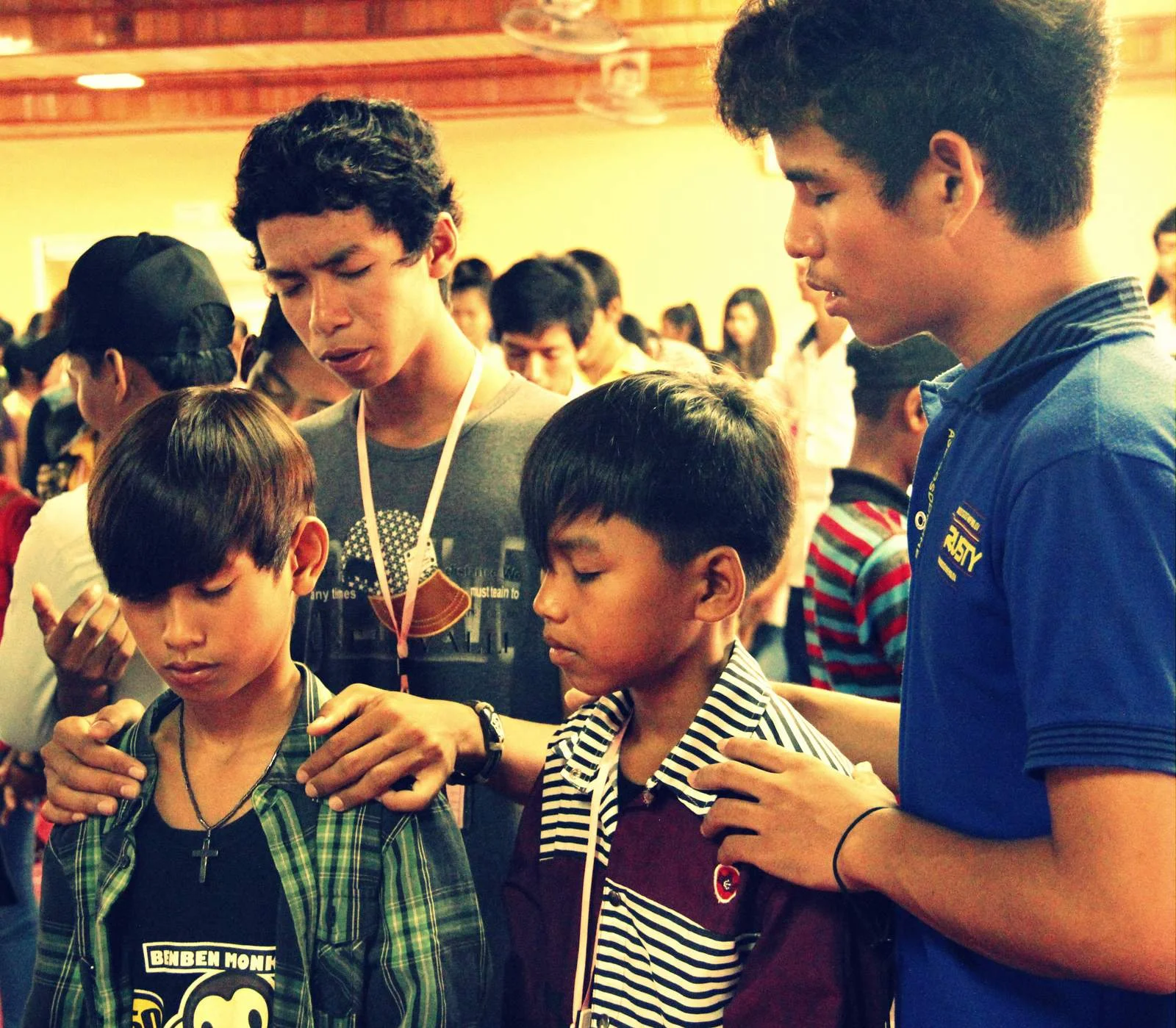
Sros (in blue) and Piset at an Alongsiders camp prayer time.
“I grew up without a father and we were very poor and it was difficult to get by. One day, a young man, Lee, who was older than me, asked me if I wanted to become his little brother…
Lee encouraged me to study hard, not to lose hope, and listen to my mom. He was always warm and friendly to me, just like my dad used to be. He invited me to attend church with him and when I believed in Jesus, my whole life changed. My studies at school, character, and obedience to my mom all improved.
Now I have my own little brother, Piset who is 12 years old. I believe this is the plan of God that God had me take on this boy as my little brother. I plan to fulfil my duties as a mentor to the best of my abilities and encourage, visit, and spend time with him, and follow up on his studies.
I really want to express my thanks for Alongsiders where I first received love, especially the love of Jesus.”